
Stone notes
Stainless steel sinks: is 16 gauge really better than 18 gauge
The question we get at the template appointment
Every kitchen job eventually gets to the sink, and someone always asks if they should pay extra for a 16 gauge sink over an 18 gauge one. The internet tells them 16 gauge is thicker, thicker means better, so spend the money. That's not wrong, exactly, but it's not the whole answer either, and treating gauge as the main thing to shop on will steer you wrong.
What gauge actually means
Gauge is just a measure of sheet thickness, and the number runs backward from what you'd expect: lower gauge number means thicker metal. 16 gauge stainless is roughly 1/16 inch thick. 18 gauge is roughly 1/20 inch thick. That's the entire difference. It's not a grade, not a quality tier, just a thickness spec.
Thicker metal does a couple of things well. It resists denting a little better if you drop a heavy pot in the sink, and it dampens sound a bit more, so water hitting the basin is a touch quieter. Those are real, small advantages. They're not the difference between a good sink and a bad one.
Where the real quality lives
The steel grade matters more than the thickness. Look for 304 stainless. It has enough chromium and nickel in the mix to resist rust and corrosion well over time. Cheaper sinks sometimes use 430 stainless, which has less nickel and is more prone to rust spots, especially around the drain. A well-made 18 gauge sink in 304 stainless will outlast a poorly made 16 gauge sink in a cheaper grade, every time.
Construction quality is the other half. A sink with good sound-dampening pads or a sprayed-on undercoating will be quieter than a bare 16 gauge basin with nothing on the underside. Welded corners versus one-piece drawn construction matters too. Radius corners (rounded rather than sharp 90 degree corners) are easier to keep clean and a little more forgiving structurally. A cheap sink can be 16 gauge and still feel tinny and flex under load if the corners are stamped thin or the rim isn't reinforced.
Those discount sinks are the big box stores are exactly that. Low quality sinks sold at cut rate prices. Exactly what you don't want in an undermount sink. Your countertops are cut to match that exact sink. If there is a problem down the road. a poor quality sink that you saved $100 on can cost you thousands when it forces you to replace your countertops.
So does gauge matter at all
A little, not much. If you're choosing between two sinks that are otherwise identical in grade and build, sure, take the 16 gauge one. It'll be marginally quieter and a bit more dent-resistant. But if the choice is between a well-built 18 gauge 304 stainless sink from a sink maker who knows what they're doing and a thin, cheaply finished 16 gauge sink from a bargain bin, take the 18 gauge sink without hesitation. Gauge is one spec on a longer list, and it's the one that happens to be easiest to print in bold on a box.
What we actually tell customers to check
- Steel grade: look for 304 stainless, not 430.
- Finish: a brushed or satin finish hides water spots and light scratches better than a mirror polish.
- Sound padding: tap the underside if you can, or ask the manufacturer's spec sheet whether it has sound-dampening material.
- Corners: rounded interior corners clean easier than sharp ones.
- Warranty: a manufacturer that stands behind the sink for 10 years or more usually built it to last that long.
Sink and countertop, working together
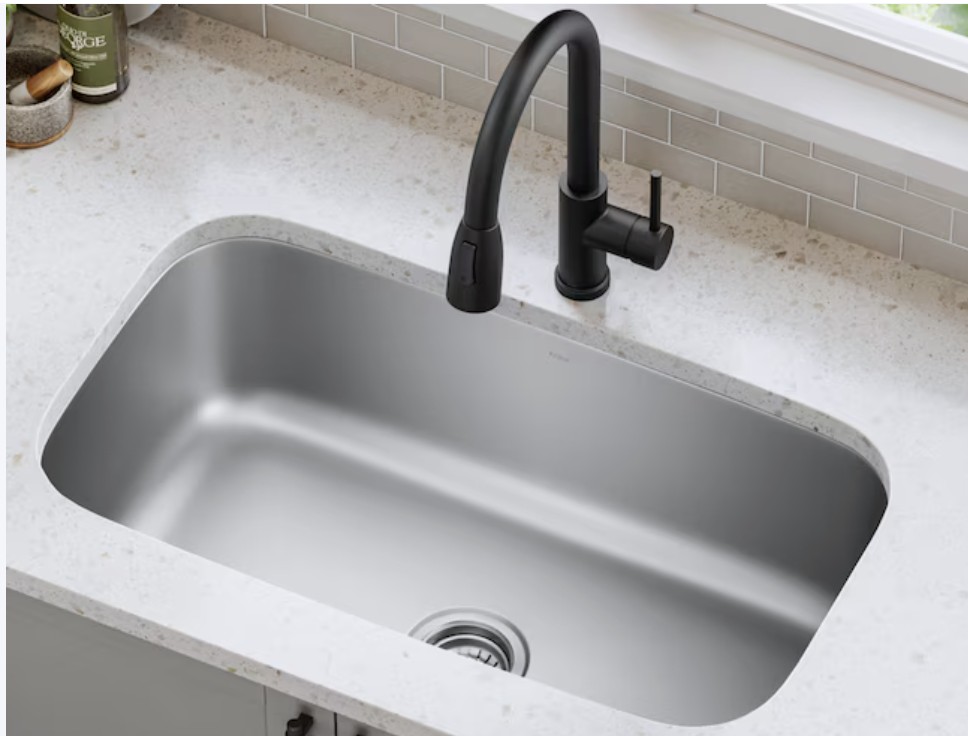
Whichever sink you land on, how it's mounted matters as much as the sink itself. An undermount stainless sink under granite or quartzite gets set with epoxy from below, and a clean edge polish along the cutout keeps water from creeping under the stone. That install work protects the countertop as much as picking a good sink protects your kitchen from dents and rust.
Don't forget we stock a huge line of top quality sinks at very competative prices here at Rocky tops. Come check out the displays in our showroom.
If you're deciding on a sink alongside a new stone countertop, bring the model number or spec sheet in when you come look at slabs. We can talk through the cutout, the mounting, and whether the sink you're eyeing is a good match for the edge profile you want. We're at 2015 Charleston Hwy in Cayce, and we'd rather help you get the sink decision right than have you overpay for a gauge number that isn't doing the work you think it is.