
The work
Why your countertops have seams (and how we hide them)
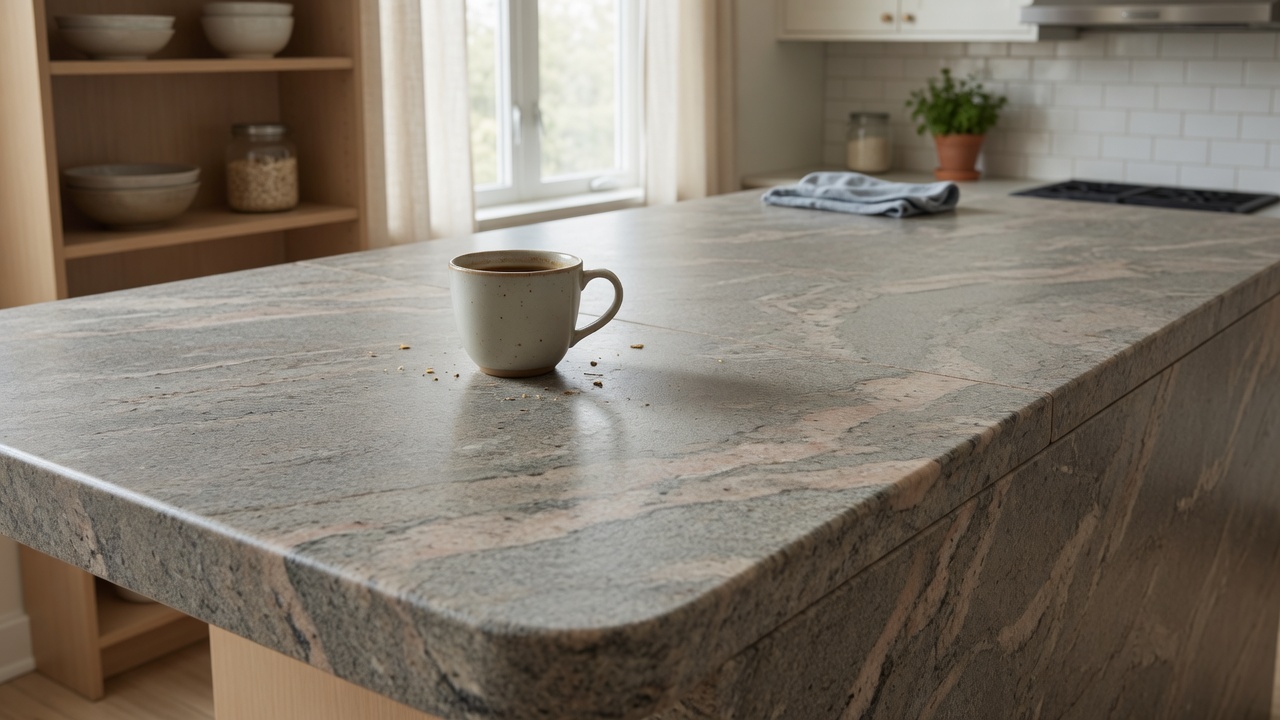
A slab of granite or quartzite comes out of the ground and the mill at a fixed size, usually somewhere around 9 to 10 feet long and 5 to 6 feet wide. Your kitchen doesn't care about that. Islands, L-shaped runs, and big wraparound counters often need more stone than one slab can give. That's the whole reason seams exist. It's not a shortcut and it's not us cutting corners. It's geometry.
The real question isn't whether a big layout will have a seam. It's where that seam goes and how well it's cut and set. That's what actually separates a seam you never notice from one that bugs you every time you wipe the counter.
Why one slab isn't always enough
A few things push a layout past what a single slab can cover:
- Total run length. A kitchen with a long L or U shape can easily add up to 20 or 25 linear feet. No slab does that in one piece.
- Islands with waterfall sides. Wrapping the stone down the ends of an island eats up a lot of the slab's length before you even get to the top.
- Slab size itself. Quartzite and some granites come in smaller block sizes than quartz or engineered stone, so natural stone jobs sometimes need a seam where a quartz layout wouldn't.
We lay out every job on the actual slab (or a full-size template of it) before we cut, specifically to figure out where a seam has to land and whether we can avoid one at all.
Where we put seams, and why
A seam's location matters more than most people think. We don't just split the difference down the middle of a countertop. We look for spots where the eye naturally skips over it:
- Away from the sink and cooktop. Water and heat stress a seam more than open counter does, so we keep seams out of those zones when the layout allows it.
- In line with cabinet seams or a wall. A seam that lines up with a cabinet break or lands where a backsplash edge sits gets visually absorbed into the room instead of standing alone in open counter.
- On the shortest, straightest run. A seam on a straight stretch is easier to cut tight and keep flat than one on a curve or near an inside corner.
- Away from where you rest your hands or set dishes down. Not for strength reasons so much as day-to-day feel. A seam under your palm at the sink is more annoying than one three feet to the side.
On an island, we'll often place the seam to fall under an overhang or in a spot the eye passes over quickly, rather than dead center where every visitor's eye lands first.
What actually makes a seam disappear (or not)
This is where the craft is. Two seams in the same kitchen can look completely different depending on how they're done.
Color and pattern matching. Before we ever cut, we book-match or pattern-match the two slab pieces so the veining and background color line up across the seam instead of jumping. This matters more on a busy, veined stone like a marble-look quartzite than on a tight, uniform granite where the pattern barely varies from foot to foot.
Seam width. A tight, well-cut seam runs about 1/16 inch, sometimes less. That's the gap the epoxy fills. Wider gaps show up as a visible line no matter how good the color match is.
Epoxy color. We tint the seam epoxy to match the stone's background color, not just grab a generic clear or white. A well-matched epoxy blends into the stone instead of drawing a hairline across it.
A flat, level joint. If the two pieces aren't perfectly level with each other, you get a lippage, a tiny ridge you can feel with your fingertip even if you can't quite see it. Getting this flat takes careful setting, shimming, and clamping while the epoxy cures.
Polishing across the joint. After the epoxy sets, we polish the seam area again so the sheen matches the rest of the slab. A seam that's color matched but left dull looks worse than one with a slightly wider gap that's polished to match.
Busy stone versus calm stone, side by side
Highly patterned stone (bold veining, big color movement):
- Pro: dramatic, one of a kind look
- Con: seams are harder to hide because the pattern has to line up exactly, and even a good match can shift slightly under different light
- Best for: buyers who want a statement piece and are willing to work closely with us on slab selection and layout
Calm, uniform stone (fine speckle, consistent background):
- Pro: seams virtually vanish because there's little pattern to mismatch
- Con: less visual drama, some people find it plain
- Best for: buyers who want the seam question to be a non-issue and don't need bold veining
Quartz (engineered):
- Pro: consistent color and pattern across every slab of the same batch, so seams match very predictably
- Con: still a seam is a seam, and on some patterns (especially ones that mimic marble veining) the printed pattern can repeat in a way natural stone doesn't
- Best for: buyers who want the most predictable seam match with the least guesswork
What we tell customers at the slab
If a seam is unavoidable on your layout, ask to see where we're proposing to put it before we cut anything. We'll walk the layout with you, show you the slab pieces side by side, and point out where the seam will fall and why. On a big island or a long run, that conversation is worth having up front rather than after installation.
No seam is completely invisible under raking light at the wrong angle. What we aim for, and what a well-cut seam should deliver, is one you forget is there once the coffee's made and the dishes are in the sink. Come by 2015 Charleston Hwy in Cayce and we'll show you real seam samples on real slabs, not just photos.