
Buying guides
Waterfall island edges: worth it or not?
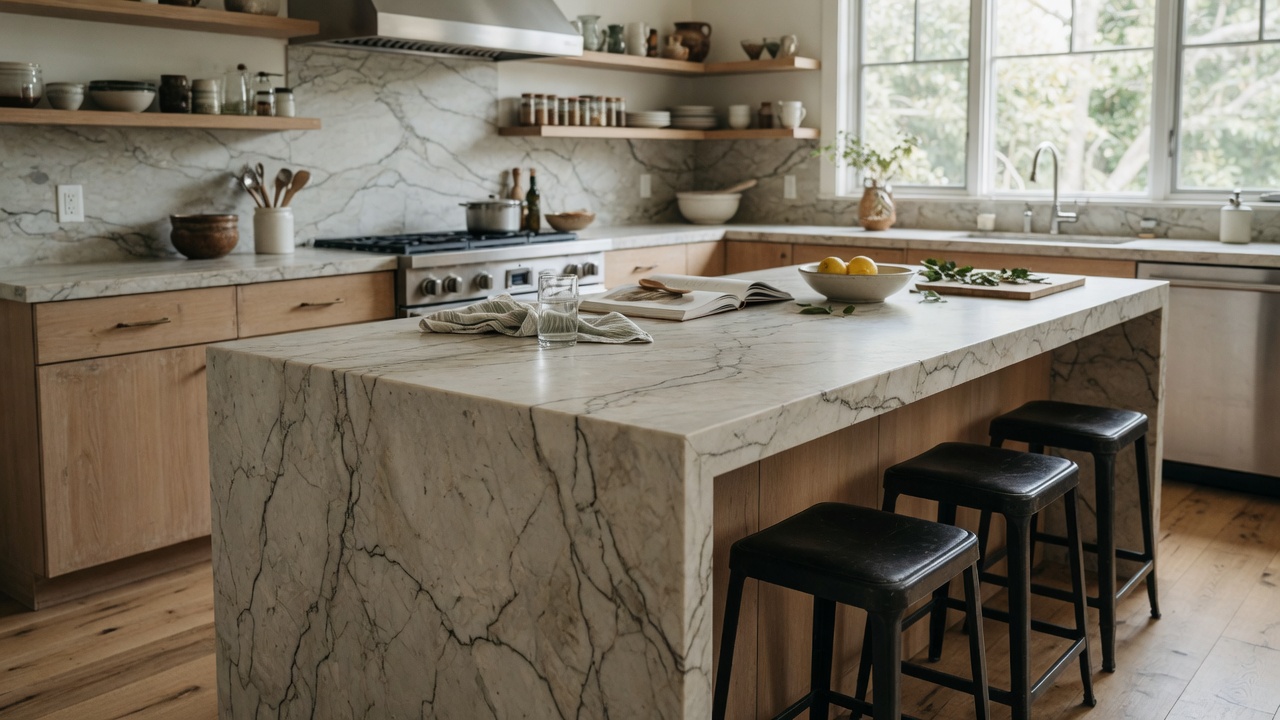
A waterfall edge is when the countertop material runs over the side of the island and down to the floor, so the vein pattern looks like it pours down the end instead of stopping at a squared edge. It's one of the best-looking things you can do with a slab. It's also one of the more expensive choices, and it's not right for every kitchen. Here's what actually goes into that decision.
What you're really paying for
A waterfall panel isn't a small add-on. It's a full extra piece of stone cut to match the island's height and depth, plus the labor to miter and join it cleanly at the corner. On top of the slab cost, you're paying for:
- Extra material (the side panel comes out of slab you'd otherwise not need)
- A mitered joint, which takes more shop time than a simple square edge
- Precise templating, since the panel has to line up with the top surface and the floor
Rough ballpark, expect a waterfall island to add a meaningful chunk to the job, often in the range of several hundred to over a thousand dollars beyond a standard edge, depending on the stone and island size. That's a wide range on purpose. Slab price, island height, and how many sides get the waterfall all move that number a lot.
The veining match is the whole game
The reason a waterfall edge looks amazing (or looks off) comes down to one thing: does the vein pattern flow naturally from the top down the side, or does it look like two unrelated pieces stuck together at a corner.
Getting that match right means:
- Cutting the top and the side panel from the same slab, often from directly adjacent sections
- Laying out the cuts before anything gets cut, so the pattern is planned, not guessed
- Losing some usable yield from the slab, since you can't always nest the pieces efficiently once you're chasing a specific vein flow
This is where a lot of the extra cost actually lives. A bookmatched or continuous-vein waterfall takes real planning time at the layout stage. Rushing this step is how you end up with a corner that looks like a mismatched puzzle piece instead of one flowing movement.
Stones that reward the look
Busy, high-contrast veining (quartzite and marble-look stones especially) shows off a waterfall edge the most, because the eye can actually follow the movement down the corner. Quieter, more uniform stones can still work, but the visual payoff is smaller since there's less pattern to carry the eye.
If you're set on marble or a calcite-based quartzite for that look, remember it still etches from acids like lemon and vinegar. That's a separate decision from the edge style, but it's worth having both conversations at the same time.
One side or two?
Most waterfall islands do it on one end, the end people see when they walk into the kitchen. Doing both ends doubles the extra material and labor, and in a lot of layouts the second end faces a wall or cabinetry where nobody will ever see it. Before you commit to two sides, walk your actual kitchen layout and think about sightlines from the doorway, the stove, and the sink.
Who should probably skip it
- If your island backs up to a wall on one or both ends, you're paying for a look nobody will see
- If your budget is already tight on slab choice, a waterfall edge on a mid-range stone often looks better than a squared edge on a stone one tier down. Weigh the trade honestly.
- If you plan to sell the house soon and want the safest, broadest-appeal choice, a clean standard edge with a nice eased or beveled profile still reads as high-end without the added cost
- If the island is small, a waterfall edge can visually overwhelm the space instead of improving it. Scale matters here.
Where it's clearly worth it
Open-concept kitchens where the island is the first thing people see, islands with real length to show off a vein pattern, and stones with strong movement all make a strong case for it. It's also a nice way to make a single striking slab feel intentional, since the whole island reads as one continuous piece of stone rather than a top with edges tacked on.
If you're on the fence, bring your kitchen photos or a rough layout by the shop at 2015 Charleston Hwy in Cayce. We can hold a few slabs up against your island dimensions and show you honestly whether the veining does anything special once it wraps that corner, or whether your money's better spent on a heavier standard edge and a nicer slab.