
Buying guides
Is travertine worth it for a kitchen?
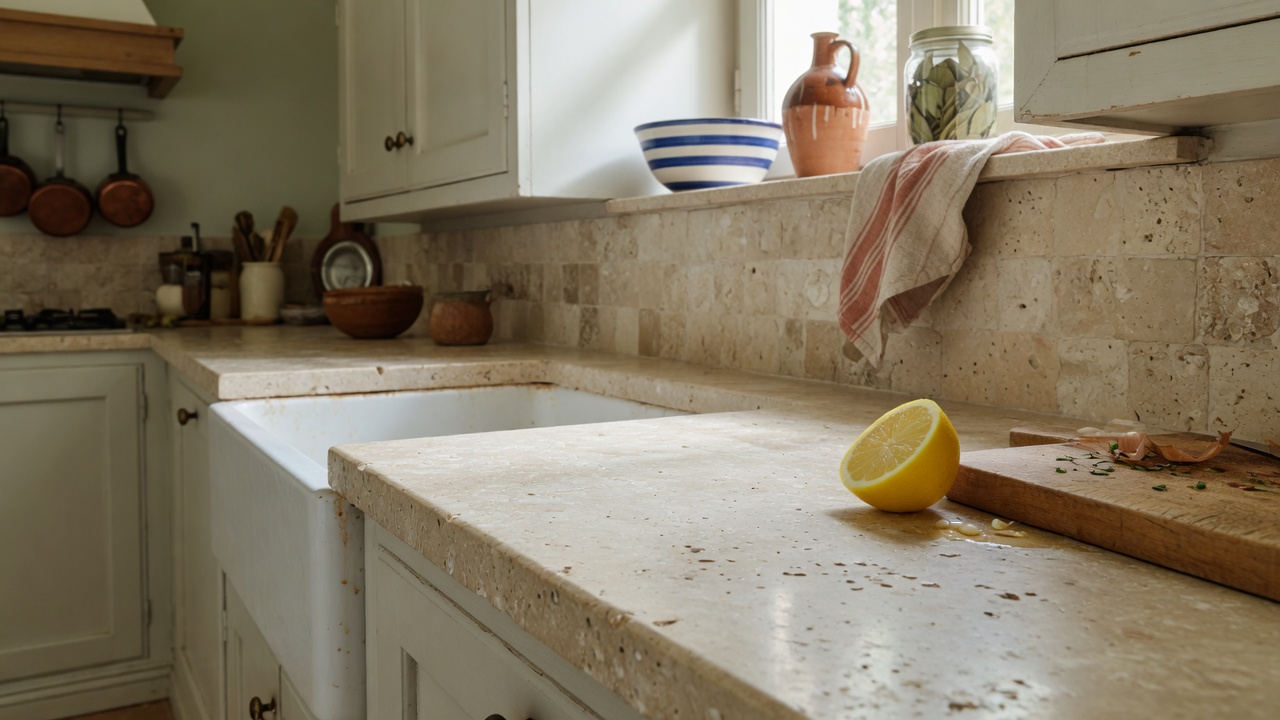
Travertine shows up in our showroom more as tile and flooring than as a kitchen slab, and there's a reason for that. It's a beautiful stone with a real history (it's been quarried and used in buildings for thousands of years), but a kitchen countertop is a harder job than a floor or a shower wall. Let's look at what you're actually getting.
What travertine is
Travertine is a form of limestone, made from mineral deposits around hot springs and mineral-rich water. That's what gives it those characteristic pits, holes, and layered, cloud-like patterns. It's a calcite stone, in the same family as marble, which matters a lot for how it behaves in daily use.
The look, and why people want it
- Warm, earthy tones. Beige, tan, walnut, ivory, sometimes a soft gray or coral.
- A natural, textured surface with visible pits and veining that reads as old-world or rustic rather than glossy and modern.
- Works well with Tuscan, Mediterranean, and farmhouse styles, and with warm wood cabinetry.
- Available honed (matte, smooth) or with the natural pits left open for a rougher, quarried look.
If you want a kitchen that feels like it belongs in an old villa, travertine does that better than almost anything else we sell.
Where it struggles as a countertop
Porosity and the pits
Those pits aren't just visual. They're actual voids in the stone, and on a countertop they catch crumbs, oil, and grime right where you're chopping onions and rolling out dough. Fabricators usually fill the pits with a resin filler before the slab ships, but fillers can wear or pop out over time with heavy use, and exposed pits need to be resealed and sometimes refilled.
Etching
Travertine is a calcite stone like marble, so it etches from acids. Lemon juice, vinegar, tomato sauce, even some wines, will leave a dull mark if they sit on the surface. That's a chemical reaction, not a stain, and sealing doesn't stop it. It's just part of owning a calcite countertop.
Softer surface
Travertine is softer than granite or quartzite. It scratches more easily, and it can chip at edges and corners if something heavy is dropped on it. A cutting board isn't optional here, it's mandatory.
Sealing and upkeep
Being porous, travertine needs to be sealed, and resealed on a regular schedule, more often than a lot of granites. Spills that sit overnight (wine, oil, coffee) can still stain even with a good seal, since sealing buys you time, it doesn't make the stone immune to every spill.
Travertine vs. granite vs. marble, side by side
Look
- Travertine: warm, pitted, rustic, one-of-a-kind veining
- Granite: speckled or veined, wide range of colors, can look modern or traditional
- Marble: classic soft veining, cool and elegant, the look travertine is often compared to
Hardness and daily wear
- Travertine: softer, scratches and chips more easily, needs a cutting board and care around dropped pans
- Granite: one of the toughest countertop stones, resists scratching well, still use a cutting board
- Marble: soft like travertine, scratches and etches similarly
Etching
- Travertine: etches from acids, calcite stone
- Granite: doesn't etch from acids
- Marble: etches from acids, same as travertine
Sealing
- Travertine: needs sealing, often more frequent resealing because of the pits and porosity
- Granite: needs sealing, typically about once a year for most kitchens
- Marble: needs sealing, similar schedule to granite but etching is the bigger daily concern
Cost
- Travertine: roughly on the lower to mid end for natural stone, often similar to or a bit less than granite, though price swings with quality and finish
- Granite: wide range, roughly 40 to 100 dollars per square foot installed depending on the material and edge work, as a rough approximate
- Marble: usually runs higher than both, especially for finer veined slabs
These numbers are rough approximates and swing with slab selection, edge profile, and job specifics. Ask us for real numbers on a stone you like.
Who travertine actually suits
- Homeowners who love the rustic, aged look and are fine with a countertop that shows some character over time (pits, small etch marks, a bit of wear) as part of its charm rather than a flaw.
- Kitchens that see light to moderate cooking, where acidic spills and heavy chopping aren't a daily event.
- People who are already comfortable with marble's upkeep and want a similar experience with a different look.
- Vanities, backsplashes, and low-traffic surfaces, where travertine's looks matter more than heavy daily wear. A lot of our customers who love travertine end up using it there and choosing something tougher for the main kitchen counter.
Who should look elsewhere
- Households that cook daily with a lot of citrus, wine, tomato sauce, or vinegar-based dressings, and want to wipe up without worrying about a dull mark.
- Anyone who wants a low-maintenance surface and doesn't want to think about resealing or refilling pits.
- Kitchens where the island doubles as a cutting surface for kids or guests who won't always grab a board.
Where we land on it
Travertine is a gorgeous stone, and we're glad to fabricate it for customers who understand what they're signing up for. For a hardworking kitchen countertop, though, most of our customers end up happier with granite or quartzite for the daily-use surfaces, and save travertine for a backsplash, a bar top, or a bathroom vanity where its softer nature isn't fighting daily abuse. Come by 2015 Charleston Hwy in Cayce and look at a few slabs in person. Seeing the pits and the color variation up close makes this decision a lot easier than looking at photos.