
The work
How we template and fabricate travertine, step by step
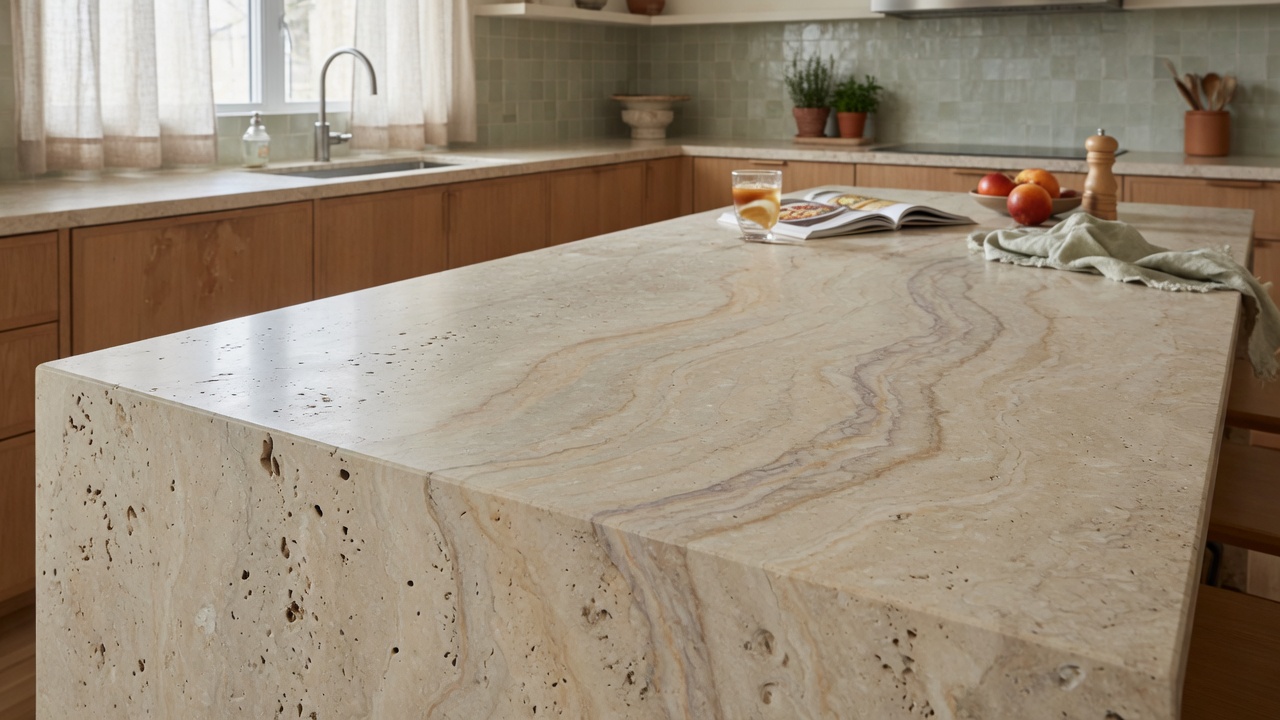
Travertine has a personality most stones don't. It's got natural pits and fissures running through it, layers laid down by mineral springs over thousands of years, and that changes how we handle it from the first measurement to the final polish. Here's the order things happen in and why.
Picking the slab first, not last
With travertine, we like to get you looking at actual slabs before we ever template. The pitting and veining vary a lot from slab to slab, and even more between fillers (some travertine comes filled with resin, some unfilled with the holes left open for a more rustic look). Knowing which slab and which finish you want changes how we plan cuts, so this step comes before anything else.
Digital templating
Once your base cabinets are set, we come out and template with a laser measuring system. It maps your cabinet layout, wall angles, and appliance cutouts down to a fraction of an inch. Kitchens are almost never perfectly square, so this step catches the real angles instead of assumed ones. For travertine specifically, we're also noting where the slab's natural fissures and open pits fall, since we don't want a seam or a sink cutout landing right on a weak spot.
Laying out the cuts on the slab
Back at the shop, we take that digital template and lay it over a photo or scan of your actual slab. This is where travertine takes more judgment than a lot of stones. We're moving the layout around to:
- Keep big open fissures or heavily pitted areas out of high-stress spots like sink cutouts or narrow bar overhangs
- Match veining and pit patterns across a seam so the two pieces read as one continuous surface
- Avoid wasting good, tight-grained sections of the slab on scrap cutoffs
This is also when we decide exactly where seams will land. Seam placement isn't random. We aim for spots where two pieces meet at a natural break in the layout, like next to a cooktop or where an island turns a corner, so the eye isn't drawn to it. A seam in the middle of an open counter is a lot more noticeable than one tucked at a transition.
Cutting and edge work
Once the layout is locked in, the slab goes on our CNC saw for the precise cuts, sink and cooktop cutouts, and edge profiles. Travertine cuts cleanly, but because it's more porous and can have those open pits, we pay attention to chipping along the edges as we go. Edge profiles get shaped and then polished, honed, or brushed to match the finish you picked for the field of the countertop.
Filling and finishing
If you chose unfilled travertine, some small pits may still show along the edges after fabrication. That's normal and part of the stone's character, not a flaw. If you went with filled travertine, we check the fill along cut edges and touch it up where needed so the surface finish is consistent from edge to edge.
Installation and the first seal
On install day, the pieces go in, seams get set and blended, and the countertop gets leveled and secured. Then we seal it. Travertine is porous, more so than granite or quartzite, so this first seal matters. We use a top-shelf sealer and our installers are trained to apply it right, so you're not left to figure out sealing on your own the week you move in. You'll still want to reseal every so often down the road, usually around once a year with normal kitchen use, but day one is covered.
Why the order matters
Every step here exists to protect the stone's character instead of fighting it. Rushing the slab layout to save time is how you end up with a seam that jumps out at you or a sink cutout weakened by a fissure that could've been avoided. Taking the time up front is what makes a finished travertine counter look like it was always meant to be exactly where it landed.
If you're weighing travertine for a kitchen or bath, come look at slabs with us at 2015 Charleston Hwy in Cayce. Seeing the pitting and veining in person tells you a lot more than a photo ever will.