
The work
How we template and fabricate Taj Mahal quartzite
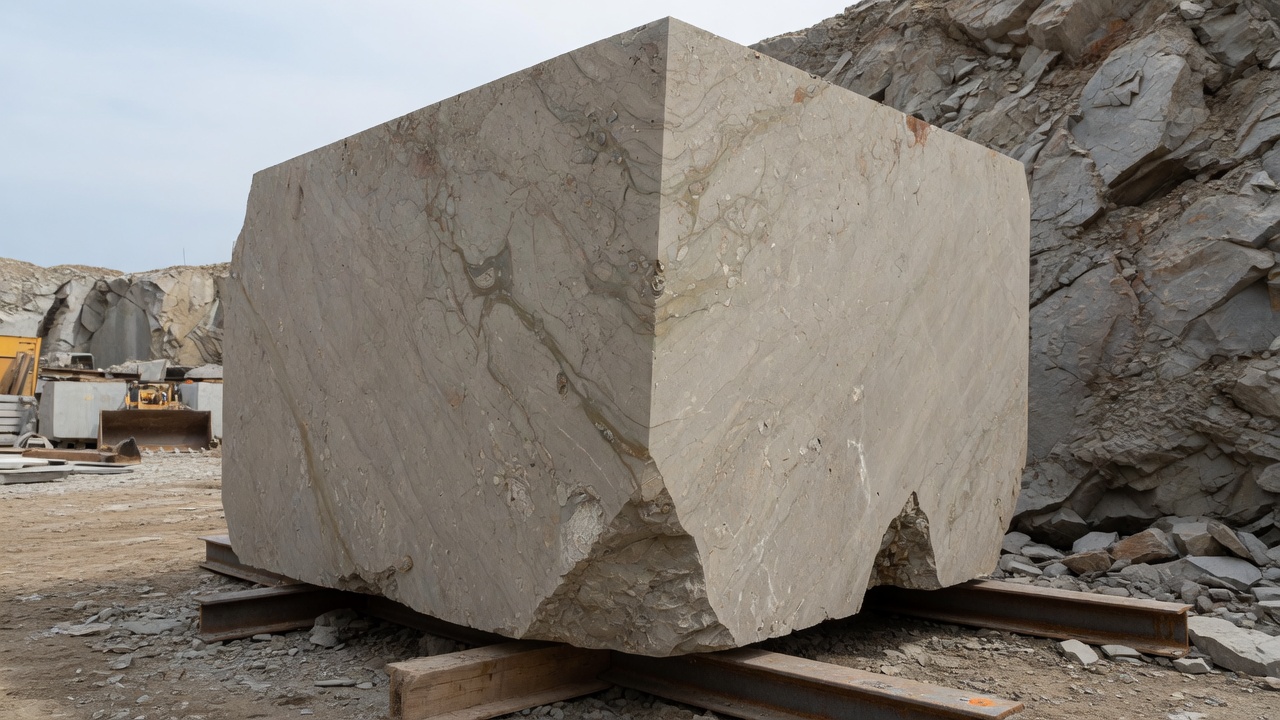
Taj Mahal is one of the most popular quartzites we work with, soft cream background, gentle waves of tan and gold running through it. Customers ask us a lot of the same questions once they've picked their slabs, so here they are, answered straight.
What actually happens at templating?
We come to your house after the cabinets are set and build a precise map of your countertop area, usually with a laser template tool or, on trickier layouts, a physical pattern. This isn't a rough measurement. We're capturing every corner angle, every appliance cutout, sink location, and wall bow down to a fraction of an inch. With Taj Mahal specifically, we also take photos of the veining direction in the room's light, because that feeds into how we lay the template over the actual slabs later.
Why do you need to see the slab before cutting, not just the template?
Taj Mahal isn't a printed pattern. Each slab has its own movement, some have soft, subtle veining, others have bolder gold streaks or a denser cluster of movement in one spot. Once we have your template, we lay it digitally or physically over your actual slabs (not a stock photo) and decide where the cuts fall. This is where we catch a busy patch that might land right where a faucet hole needs to go, or a nice quiet stretch we want to save for the main run in front of the sink.
Why does the seam end up where it does?
Seam placement comes down to three things: slab size, kitchen layout, and vein direction. Slabs come in a fixed size, usually around 9 to 10 feet by 5 to 6 feet, so any run longer than that needs a seam somewhere. We try to put seams in low-traffic, low-light spots, like just past a stove or off to the side of a sink, rather than dead center of your main workspace. We also try to match veining across the seam so your eye reads it as one continuous piece rather than two slabs bumped together. On a stone like Taj Mahal, with its long, flowing bands, getting that match right takes real attention at the layout stage, not just at the saw.
What happens when the slab actually gets cut?
Once layout is approved, our fabricators cut the slab on a CNC saw programmed from your template, so every cutout, corner radius, and edge matches your kitchen exactly. Edges get profiled and polished by hand and machine together, since a clean edge is part craft and part machine precision. Sink and cooktop cutouts get cut and finished at this stage too, with the edges eased and smoothed so there's no sharp or rough lip.
Does Taj Mahal need anything special during fabrication?
It's a hard, dense stone as quartzites go, which is part of why people like it, it resists scratching better than marble. But it still needs a cutting board, and it still needs sealing since it's a natural, porous stone. We seal every job at install with a quality sealer, applied by installers we train specifically for it. You'll want to reseal every so often down the road, usually about once a year for a busy kitchen, but the first and most important seal is already done by the time we hand you the keys.
What happens on install day?
We bring the finished pieces in, set them on the cabinets, level everything, and join any seams with a color-matched epoxy that we polish flush once it cures. We check the seam lines in daylight before we call it done, because that's when veining mismatches or lippage actually show. Then it's a final clean and a walk-through with you.
If you want to see how Taj Mahal actually looks in slab form, veining varies more than photos suggest, come by 2015 Charleston Hwy in Cayce. We're happy to walk the yard with you and talk through layout before you commit to anything.