
Care and maintenance
Heat, scratches, and Taj Mahal quartzite: what's actually true
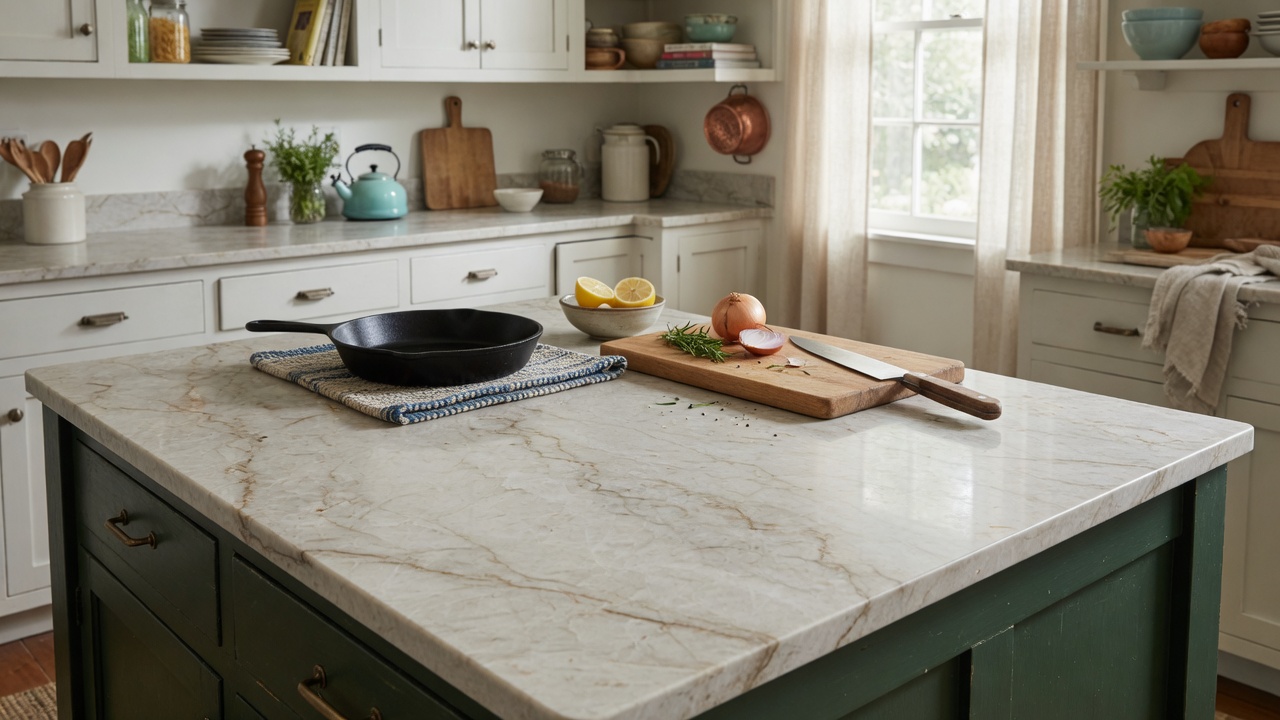
Taj Mahal gets talked about like it can survive anything you throw at a kitchen. It's a beautiful stone and a hard one, but we'd rather tell you exactly what it does than let a showroom rumor set your expectations.
What Taj Mahal quartzite actually is
Taj Mahal is a true quartzite, quartz sand compressed and heated deep underground until it's dense and hard. That's different from the softer, calcite-based stones that sometimes get sold under a "quartzite" name but etch like marble. Real quartzite like Taj Mahal is one of the harder natural stones we fabricate, and it shows in daily use.
Heat: better than most, not immune
- Taj Mahal handles brief contact with a hot pan better than most kitchen surfaces. The mineral structure isn't bothered by short bursts of heat the way a resin-based surface can be.
- We still don't call any stone heatproof, because no stone earns that word. Thermal shock, setting a pan straight from a 450 degree oven onto a cold slab, can still stress any stone over time.
- Use a trivet or hot pad. Every time. It costs you nothing and it protects the stone's finish from any long-term heat marking near seams or edges.
Scratches: tough, not untouchable
- Quartzite ranks close to quartz crystal on the hardness scale, which is why it resists scratching so well. Everyday use, pots, pans, silverware, sliding a mixer across the counter, generally won't leave a mark.
- A knife blade is harder in a specific, thin edge, and using one straight on the stone can still leave a fine scratch over time, especially on a honed (matte) finish where marks show more easily than on polished. Use a cutting board and you avoid the issue altogether.
- Cutting boards aren't optional in our book. They protect your knife edges as much as they protect the counter. A blade dragged across stone dulls fast.
- Grit matters too. Sand, dropped screws, or gritty debris under a heavy pot can scratch even a hard stone if you drag it instead of lifting it.
Sealing and staining, the part people skip
- Taj Mahal is porous like all natural stone, just less porous than marble or limestone. It should be sealed, and we do that at install with a good sealer applied by installers we train specifically for this.
- Sealing buys you time against spills, it doesn't make the stone immune to staining. Wine, coffee, oil, and citrus juice left sitting overnight can still soak in and leave a mark, especially on a honed finish.
- Plan to reseal roughly once a year for a kitchen that sees regular use. Kitchens that cook a lot, more oil, more acid, more traffic, may want it a little sooner.
- Being a true quartzite, Taj Mahal resists etching from lemon juice or vinegar better than marble, which is calcite-based and etches from acids no matter how well it's sealed. Sealing helps with stains, but it doesn't stop an acid reaction, that etching on marble is normal patina, not a defect, and it's one of the real reasons people choose a genuine quartzite over marble when they want a similar look with less babying.
Where the name causes confusion
A lot of slabs get sold as "quartzite" that are really calcite-based stones dyed or marketed to look the part. Those etch the way marble does. Genuine Taj Mahal, sourced correctly, is quartz-based and holds up to acids far better than marble. When you're shopping, ask the yard to confirm it's a true quartzite, not just trust the tag. We test slabs by how they behave, not just by their trade name, and we're happy to show you that in person.
The short version
Taj Mahal is one of the more forgiving stones we install for a busy kitchen. It shrugs off a lot that would mark a softer surface. But "resists scratching" and "handles heat better than most" are honest descriptions, not guarantees, and we'd rather give you the plain version than a sales pitch. Use a trivet, use a cutting board, wipe up spills before bed, and reseal it once a year. Do that and the slab will look good for a long time.
If you want to see how a Taj Mahal slab actually catches light and feels under your hand, come by 2015 Charleston Hwy in Cayce. We'll show you a few cuts side by side and point out exactly where the veining runs so there's no surprise once it's on your counters.