
Buying guides
Is soapstone worth it for a kitchen?
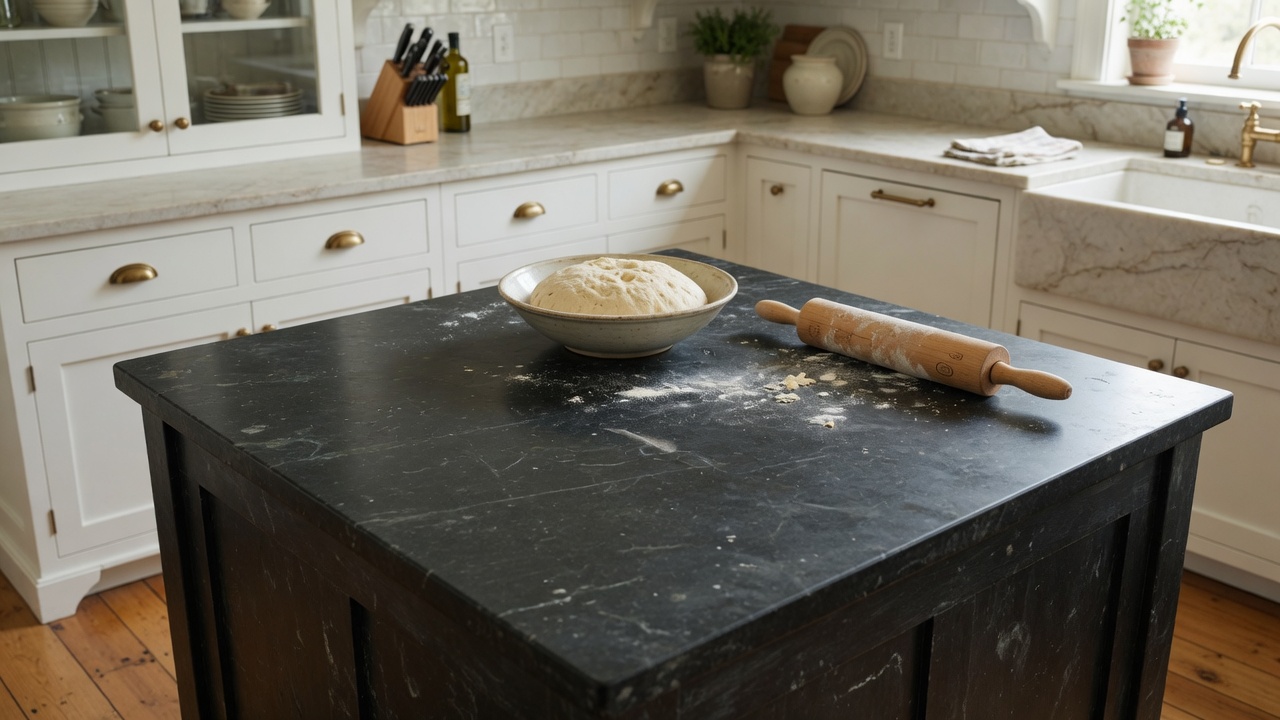
Soapstone comes up a lot with customers who've seen it in an old farmhouse kitchen or a magazine photo and fallen for that soft, matte look. It's a good stone. It's just a different kind of commitment than granite or quartz, so let's go through the real questions.
What does soapstone actually look like?
It's quiet. Usually gray to charcoal, sometimes with a green cast, and the veining is soft rather than dramatic. No sparkle, no big color swings from slab to slab. If you want something loud, soapstone isn't it. If you want a calm, almost chalky matte surface that looks like it belongs in a farmhouse or a century-old kitchen, it's hard to beat.
Is it durable enough for daily cooking?
It holds up well to heat, better than most stones actually, because it's dense and doesn't have resin in it the way quartz does. A hot pot straight off the stove is about as safe on soapstone as any stone gets, though we still say use a trivet, because thermal shock and uneven heating can still cause problems over time.
Where it's softer is scratch resistance. Soapstone is a talc-based stone, softer than granite or quartzite, and it will pick up scratches from knives and grit. Most owners come to see those marks as part of the surface's character rather than damage, but if you want a pristine, scratch-free counter forever, this isn't your stone.
Does it stain or need sealing?
Soapstone is naturally low-porosity, lower than granite in most cases, so it resists staining fairly well on its own. Some owners still apply mineral oil periodically, not to seal it exactly, but to even out the color and darken it toward that deep charcoal look. Skip the oil and it stays lighter gray with more visible variation. Either way, it's not the same sealing routine as granite or marble. Wipe up spills when they happen, same rule as any countertop.
What about the darkening and patina over time?
This is the thing to understand before you buy. Soapstone darkens with age and use, especially with oiling, and it develops a patina that shows where you've worked, cut, and set things down. Some people find that beautiful, the stone telling the story of the kitchen. Others find it looks worn or dirty. There's no right answer, but you should see an aged sample, not just a fresh slab, before you commit.
Can I fix scratches myself?
Yes, actually, this is one of soapstone's advantages. Because it's soft, light scratches can often be sanded out with fine sandpaper and blended back in, then re-oiled if you're using the oil routine. That's a DIY-friendly repair you generally can't do on granite or quartz. It won't make the stone scratch resistant, but it does mean small damage isn't the end of the world.
What does it cost compared to granite or quartz?
Soapstone usually runs somewhere in the same neighborhood as mid to upper granite, roughly 60 to 120 dollars per square foot installed depending on the slab and thickness, though exact pricing depends on what's available at the time. It's not usually the cheapest option, but it's not the most expensive either.
Who should choose soapstone, and who shouldn't?
It suits people who like a matte, old-soul look and don't mind a surface that shows its age. Bakers like it because it stays cool and resists staining from flour and dough. It's a poor fit for anyone who wants a pristine, scratch-free counter or who's set on bright colors and bold veining.
If any of that sounds like your kitchen, come look at a few slabs in person at 2015 Charleston Hwy in Cayce. Seeing an aged sample next to a fresh one tells you more than any photo will.