
The work
How we template and fabricate soapstone
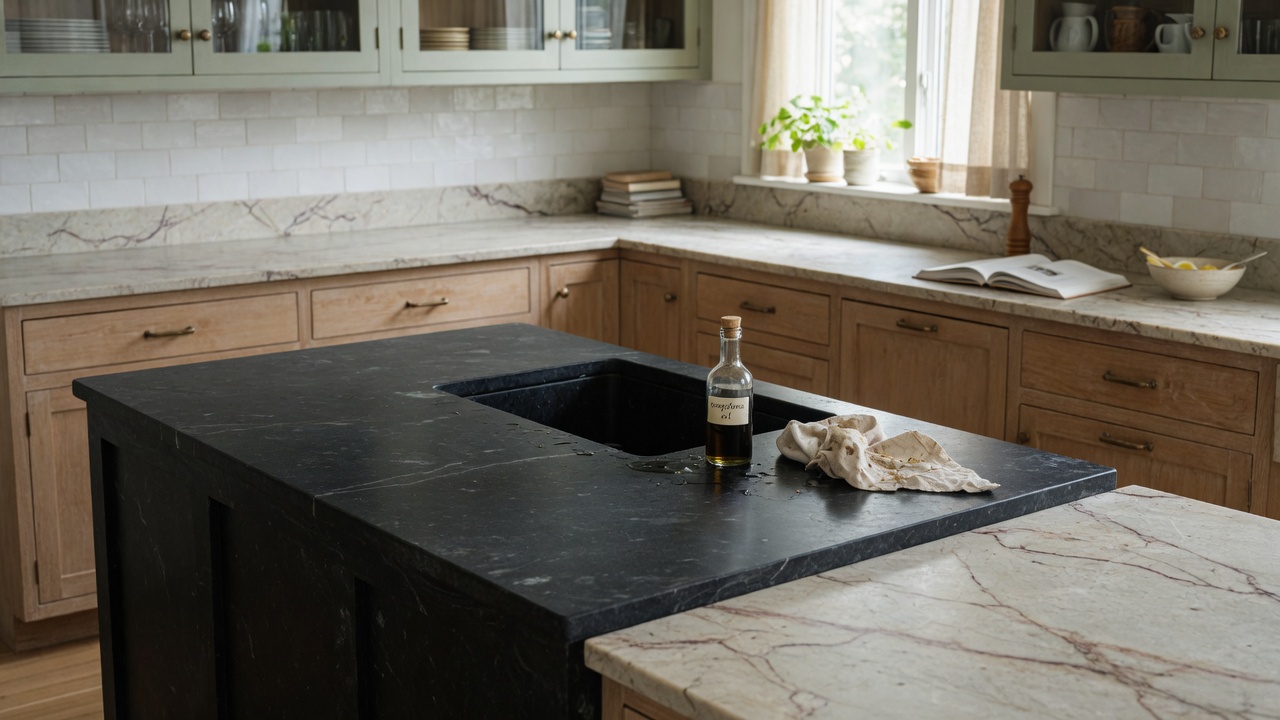
Soapstone isn't granite with a different name. It's softer, it moves under a saw differently, and it forgives some mistakes while punishing others. Here's how a soapstone job actually goes from raw slab to installed countertop in our shop.
Templating starts with the slab, not the kitchen
With granite or quartz we can often template a kitchen before the slab is even picked, since the stone is consistent enough that layout doesn't depend on it. Soapstone is different. Veining and mineral streaks vary a lot from slab to slab, so we like to have the actual slab selected first. We lay out the template digitally, then hold it against the slab (or a photo of it) to plan where the good veining lands on the island, the sink run, wherever your eye goes first.
Why the sink cutout gets extra attention
Soapstone is talc based and softer than granite or quartzite. Cutting a sink opening puts stress right at the corners, and that's where a softer stone is most likely to crack if it's rushed. We take our time on those cuts, use full support underneath during fabrication, and don't force the saw. It costs a little more time in the shop. It's worth it.
Seams land where the stone tells us, not where it's convenient
Same rule as any natural stone: we place seams at the narrowest visual point, usually flanking a sink or stove, and we try to keep them out of high-traffic sightlines. With soapstone there's an added wrinkle. Since the color is often a solid dark gray or green with veining, a seam has nowhere to hide the way it might in a busy granite pattern. We plan seam placement around the veining specifically so the two pieces read as one continuous vein where they meet, not just one continuous color.
Fabricating soapstone means slower feed rates
Our saws run slower on soapstone than they do on granite or quartzite. Push too fast and you risk chipping the edge or putting stress cracks in a stone that doesn't have the hardness to shrug it off. Edge profiles get the same treatment. A simple eased edge or a bullnose is standard on soapstone for a reason: soft, rounded profiles hold up better on a stone that dents and chips more easily than a knife-edge miter would.
The color you see in the shop isn't the color you'll live with
Raw soapstone usually comes out of the ground light gray, sometimes with a greenish cast. It darkens over time from handling oils and from the mineral oil or wax finish most people apply. We tell every soapstone customer this up front, because a slab that looks pale gray in our shop can end up looking almost black in your kitchen after a few months of use. That's normal and it's part of what people like about the stone, but it's not a surprise we want you to discover on your own.
Installation asks for patience with weight and flex
Soapstone slabs, especially thicker ones, can flex more than granite before they're fully supported. During install we make sure base cabinets are level and any unsupported spans (like an overhang for seating) get plywood or a corbel underneath. Skipping that support is one of the most common reasons a soapstone top cracks after installation, and that's almost never the stone's fault when it happens. It's a support problem.
Sealing and oiling isn't optional the way it is with quartz
Soapstone is dense and naturally resists staining better than a lot of natural stones, but it's still porous enough to need some care. Most fabricators, us included, send soapstone out with an initial mineral oil treatment, and we walk every soapstone customer through how to reapply it themselves. That's not the same as sealing granite. It's more like conditioning leather. Skip it and the stone still works fine, it just stays lighter and shows water marks more.
Small chips are fixable, and that's part of owning soapstone
Because the stone is soft, small edge chips can happen over years of use, especially at outside corners. The fix is straightforward: a little fine sandpaper and some mineral oil blends most small chips back into the surface. We tell customers this not to scare them off soapstone, but because knowing the fix ahead of time makes it a non-issue instead of a crisis when it happens.
If you're weighing soapstone against granite or quartzite, come by 2015 Charleston Hwy in Cayce. Seeing a slab in person, and running a hand over one that's already darkened from age, tells you more in five minutes than any spec sheet will.