
Care and maintenance
Soapstone and heat, soapstone and scratches: what's actually true
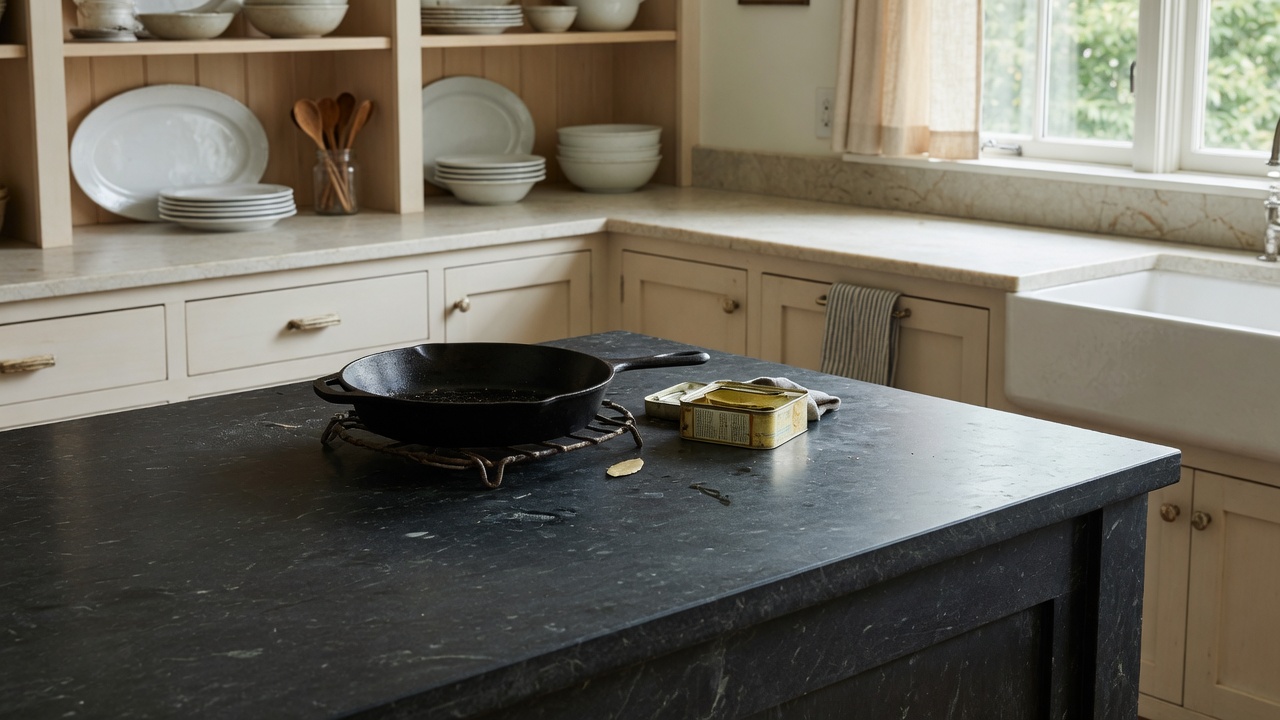
Soapstone has a good reputation, and a lot of it's earned. It's also gotten a little exaggerated over the years, especially online, where people repeat things about it without ever having lived with a slab in their own kitchen. Here's how it actually behaves.
Where the heat reputation comes from
Soapstone is mostly talc and other soft minerals, and it's been used for wood stove surrounds and lab counters for a long time because it holds up to heat well. That history is real. It's part of why people assume you can set anything hot on it without a second thought.
In our shop, we still tell every soapstone customer to use a trivet. Soapstone handles direct heat about as well as any countertop material we sell, but repeated thermal shock (a screaming hot pan straight from the stove, set down cold) can still stress any stone over time. A trivet costs a few dollars. Replacing or repairing a countertop doesn't.
Where the scratch reputation gets it backwards
This is the part people get wrong most often. Soapstone is soft, softer than granite or quartzite by a good margin. It will scratch. A knife dragged across it, a cast iron pan slid instead of lifted, even a fingernail with enough pressure can leave a mark.
The upside: soapstone is easy to fix. Fine sandpaper or steel wool buffs out light scratches, and mineral oil brings the color back afterward. Granite and quartzite resist scratching much better going in, but if they do get damaged, that repair is a bigger job for a professional. Soapstone trades scratch resistance for easy DIY touch-up.
We still recommend a cutting board on soapstone, same as any stone. It protects your knives more than it protects the counter, but it also keeps you from creating extra buffing work for yourself.
Soapstone side by side with granite and quartzite
Heat
- Soapstone: handles direct heat well, has a long history in high heat settings, still wants a trivet for hot pans.
- Granite and quartzite: also handle brief contact with a hot pan better than most surfaces, still want a trivet every time.
- Quartz: the one that actually needs the most caution here. It's engineered with resin, and a hot pan can scorch or discolor it.
Scratching
- Soapstone: soft, will scratch with normal kitchen use, but scratches buff out easily with sandpaper and oil.
- Quartzite: one of the hardest stones we sell, resists scratching better than marble or soapstone, still use a cutting board.
- Granite: also resists scratching well, cutting board still recommended.
Staining and sealing
- Soapstone: dense and low absorbing, often sealed with mineral oil rather than a penetrating sealer, though some customers skip sealing entirely and let it darken naturally over time.
- Granite and quartzite: porous to some degree, should be sealed and resealed periodically, usually about once a year for most kitchens.
- Quartz: non-porous, no sealing needed at all.
Look and feel over time
- Soapstone: darkens with age and oiling, develops a patina people either love or don't. It's not going to look brand new in five years, and that's the point for a lot of folks who choose it.
- Granite: keeps a pretty consistent look over decades with basic care.
- Quartzite: similar to granite, holds its look with sealing and normal care.
Who soapstone actually suits
Soapstone makes sense for someone who wants a living surface, one that shows use and changes color as it ages, and who doesn't mind the maintenance rhythm of oiling it every so often. It's a good fit near a wood stove, in a farmhouse style kitchen, or for someone who's already decided they like the patina look rather than fighting it.
It's a tougher sell for someone who wants a counter that looks the same on day one and day 3,000 without any upkeep. If you want minimal maintenance and maximum scratch resistance out of the gate, granite or quartzite is the better match. If you want zero sealing ever and a very consistent surface, quartz is worth a look too, keeping in mind the heat caution that comes with it.
The bottom line on both fears
Soapstone won't scorch or crack from a normal hot pan any more readily than most stone, but it's not immune to thermal stress, so use a trivet. It will scratch more easily than granite or quartzite, but those scratches are some of the easiest damage to fix on any stone we sell. Neither fact should scare you off soapstone. Both are just things to know going in, so the counter you pick matches how you actually cook and live.
If you want to see how a soapstone slab feels in person, how heavy it is, how the color varies piece to piece, come by 2015 Charleston Hwy in Cayce. We keep several slabs on the floor and we're happy to run a piece of steel wool across a sample so you can see the scratch and buff-out for yourself before you commit to anything.