
Care and maintenance
Soapstone countertop care: myths versus what actually happens
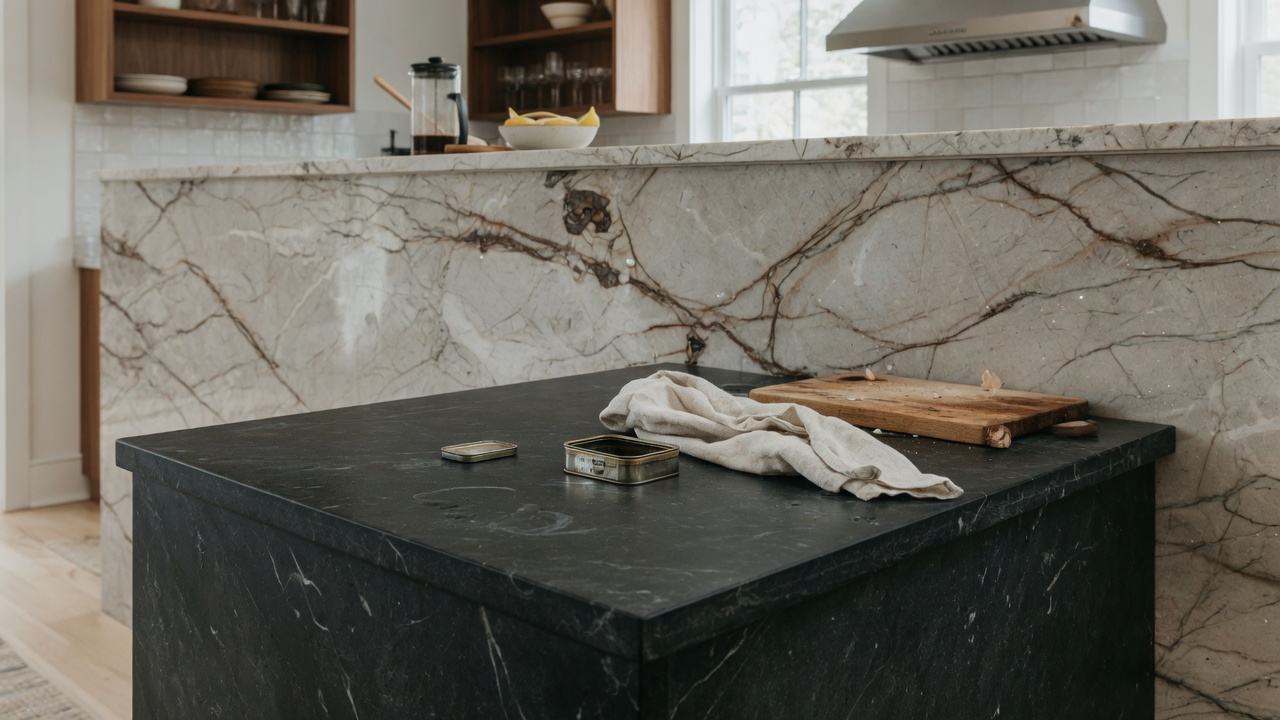
Soapstone has a reputation that runs ahead of the facts. Old farmhouse sinks and lab counters were made from it, so people assume it can take absolutely anything. Some of that's true. Some of it isn't. Here's what we tell people who are actually about to live with it.
Myth: soapstone doesn't need any care at all
You'll hear soapstone is a "set it and forget it" stone. It's low maintenance compared to a lot of natural stone, but it still asks something of you. Soapstone is dense and non-porous compared to granite or marble, so it doesn't need sealing the way those stones do. It does, however, darken and develop a patina over time, especially where it gets touched, wiped, and used most. Most owners apply mineral oil periodically (some do it weekly at first, then taper off) to even out that color change and bring out the stone's natural dark tone faster. Skip the oil and the stone still works fine, it just ages unevenly and slower, with lighter patches where it's been scrubbed and darker patches where oil, grease, or hands have touched it most.
Myth: soapstone can't scratch
Soapstone is actually one of the softer stones we sell, softer than granite or quartzite. It will scratch, and it will scratch more easily than those harder stones. The upside is that scratches are usually shallow and can often be worked out with fine sandpaper (people use 220 to 400 grit) followed by a fresh coat of mineral oil to blend the repaired spot back in. That's a real feature, most stones can't be sanded and touched up by the homeowner. But don't mistake "repairable" for "scratch-proof." Use a cutting board for chopping, the same as you would on any countertop.
Myth: soapstone can take any amount of heat
Soapstone has a real history in wood stoves and lab counters, so people assume you can set anything hot on it without a second thought. It does handle heat better than most surfaces, and it's genuinely one of the better stones for a hot pan set down briefly. Even so, we still recommend a trivet or hot pad. Repeated direct heat over the same spot, over years, isn't something we'd bet a customer's countertop on, and there's no reason to risk it when a trivet solves the problem completely.
Myth: soapstone stains easily because it's soft
Softness and staining are different things. Because soapstone is non-porous, it actually resists staining better than granite or marble. Wine, oil, and citrus don't soak in the way they can on a porous, unsealed stone. That's one of soapstone's genuine strengths. It also holds up well against lemon juice and vinegar, since it isn't a calcite stone like marble and doesn't react to acids the same way. Spills still ought to get wiped up as a matter of habit, but you're not racing the clock the way you're with some other natural stones.
What day-to-day care actually looks like
Wash with mild soap and water. Skip harsh chemical cleaners, they can dull the finish faster than normal wear. Apply mineral oil on your own schedule, driven by how much color variation you're comfortable seeing. Use cutting boards and trivets as a matter of course, not because the stone demands special babying, but because it's just good practice on any countertop.
Soapstone rewards people who like a material that shows its use rather than one that stays showroom-perfect forever. If that sounds like your kitchen, come by our shop at 2015 Charleston Hwy in Cayce and put your hands on a few slabs. Seeing the color range and running a hand over the texture tells you more than any care guide can.