
The work
How we template and fabricate quartzite, start to finish
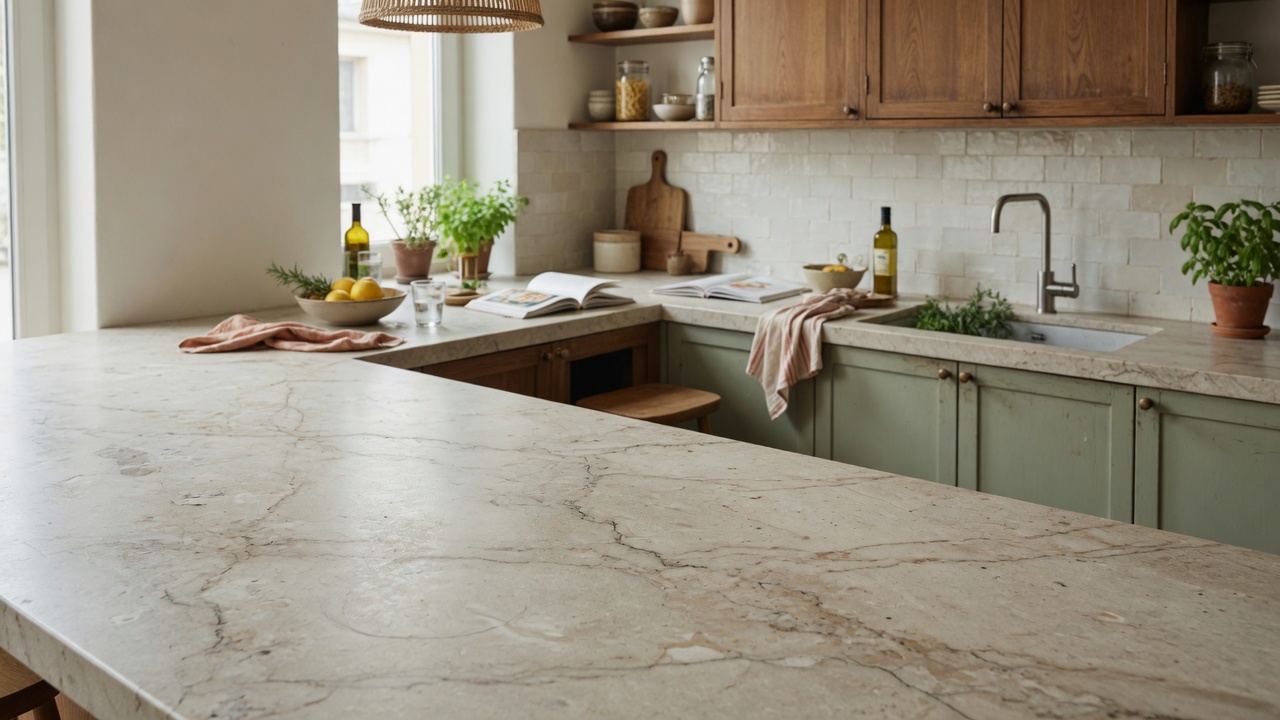
Quartzite is one of the harder stones that comes through our shop, and it changes how we work at almost every step. Here's what actually happens between the day you pick a slab and the day it's bolted down in your kitchen.
Step one: templating your cabinets, not the slab
Before we touch stone, we come to your house and template the base cabinets with a laser measuring arm. This isn't a tape measure and a guess. We're capturing every wall angle, every cabinet edge, sink and cooktop cutout locations, and any out-of-square corners (most kitchens have at least one). That digital template becomes the map we cut from later.
We template after cabinets are set and before the slab is cut, because quartzite doesn't flex or forgive. If a wall is bowed an eighth of an inch, we need to know that now, not after the stone is on your counter.
Step two: picking the slab and laying out the cuts
Quartzite slabs vary a lot, more than most people expect. Movement, veining, and color can shift across a single slab, so we walk you through picking the actual slabs (plural, if your kitchen needs more than one) before we cut anything.
Once we have the slab and the template, we lay out the cuts digitally on a full picture of the slab's face. This is where we decide where the island goes, where the perimeter runs, and where any seams have to land. We try to keep veining and pattern flowing across seams so they read as one continuous piece instead of two slabs bumped together.
Step three: why seams land where they do
Nobody loves a seam, but a few things force our hand. Slabs come in a fixed size, usually around 9 to 10 feet long, so a run longer than that needs a seam somewhere. We place seams over base cabinets rather than in open spans, away from the sink whenever possible, and in a spot where the pattern lines up cleanest. On a busy quartzite with strong movement, we'll sometimes shift a seam a few inches from the