
Care and maintenance
Heat, scratches, and quartzite: sorting the myths from the truth
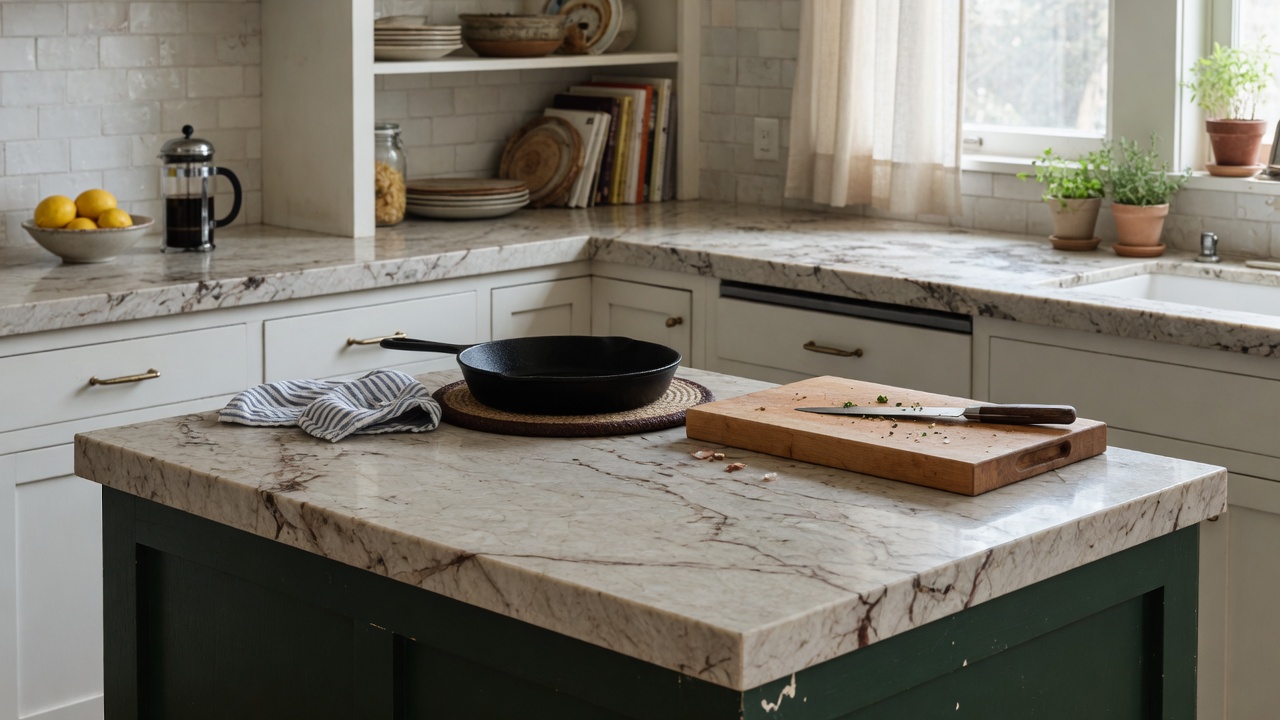
Myth: quartzite can take anything you throw at it
We hear this one a lot at the shop. Someone's picked out a gorgeous slab of quartzite and the salesperson at another store told them it resists just about anything, no trivet or cutting board needed. That's the myth, and it's not quite right.
Quartzite is genuinely one of the toughest countertop stones we sell. It started as sandstone and got compressed and heated deep in the earth until the quartz grains fused together, which is why it's harder than granite in most cases and holds up to daily kitchen abuse better than a lot of surfaces. But "holds up well" and "you can do anything to it" are two different things, and the gap between them is where people end up disappointed.
The honest word on heat
Quartzite handles brief contact with a hot pan better than most countertop materials. That's true. But we still tell every customer to use a trivet or hot pad, every time, no exceptions. Why? Thermal shock is real. A pot straight off a high burner set down on a cold slab can cause stress in the stone over time, especially near seams or edges. It's rare, but it happens, and there's no way to guarantee it won't. A trivet costs a few dollars. A cracked slab costs a lot more.
The honest word on scratches
Quartzite resists scratching better than marble and better than most softer stones. Chefs like it for that reason. But "resists" isn't "can't be scratched." Ceramic knives, ceramic-blade choppers, ceramic mixer bowls dragged across the surface, ceramic anything really can leave a mark if you're not careful. Ceramic is one of the few materials as hard as quartzite itself. And even a quality steel knife can catch on a rough edge over time and dull, even if it doesn't gouge the stone.
Use a cutting board. It's not because quartzite is fragile. It's because your knives deserve better than direct contact with any stone, and because "resists scratching" still leaves room for a scratch under the wrong conditions (grit under the blade, a hard drag, an unlucky angle).
What quartzite still needs from you
Quartzite is natural stone, and natural stone is porous to some degree, even the dense stuff. That means it should be sealed, and resealed periodically, usually about once a year for a kitchen that sees regular use. Sealing helps it resist stains from wine, oil, and citrus, but even a well-sealed quartzite can pick up a stain if a spill sits overnight. Wipe it up when it happens and you'll be fine.
One more thing worth knowing: not everything sold as "quartzite" actually is quartzite. Some slabs marketed under that name are softer calcite stones that etch like marble when lemon juice or vinegar hits them. That's a naming problem in the industry, not a flaw in true quartzite. We go by how a slab actually behaves, scratch test and acid test included, not just what the tag says.
Where that leaves you
Quartzite is a great choice for a busy kitchen. It handles heat and scratches better than most stones we sell. It's not magic, and it's not a material you can treat carelessly and expect zero consequences. Trivet under the pan, board under the knife, wipe up spills, reseal now and then. Do that and a good quartzite countertop will look right for decades.
If you want to see the difference between real quartzite and something wearing the name, come by 2015 Charleston Hwy in Cayce. We'll show you slabs side by side and explain what you're actually looking at.