
Local
Quartzite countertops for Lexington homes: what to know before you pick a slab
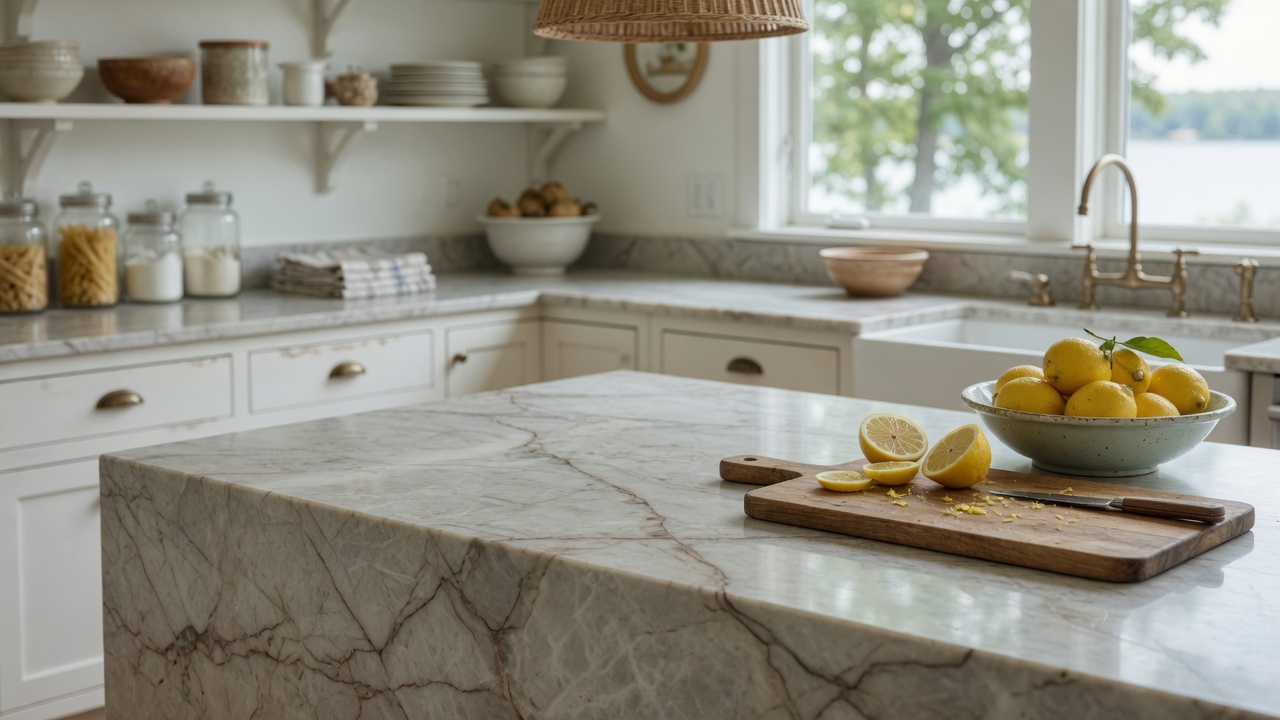
Lexington sends us a lot of the same kind of project: newer construction off Sunset or Corley Mill, lake houses out toward Lake Murray, and a steady stream of kitchen remodels in the older neighborhoods near downtown. Quartzite comes up in almost every one of those conversations now, usually because someone saw it on a renovation show or heard a neighbor mention it. It's a good stone. It's just not the only stone, and it's not automatically the right one for every kitchen.
Here's how we'd walk you through it if you came by the shop.
What quartzite actually is
Quartzite starts as sandstone and gets compressed and heated underground until it turns into a much harder rock. That process is what gives it a lot of its reputation. It's one of the harder natural stones we fabricate, and it resists scratching better than marble.
One catch worth knowing up front: not every slab labeled "quartzite" at a yard actually is quartzite. Some slabs sold under that name are really a softer calcite stone that etches like marble. A trade name on a sticker isn't a guarantee. We test how a slab behaves before we tell a customer what to expect from it.
Quartzite vs. granite for a Lexington kitchen
Both are hard, both come from igneous or metamorphic processes, and both are good choices for a busy family kitchen. Here's where they actually differ:
- Look: Granite tends to have more consistent speckled or granular patterns. Quartzite often has softer, more movement-heavy veining that can look closer to marble, which is why it gets picked for kitchens that want a marble look with tougher everyday performance.
- Hardness: Quartzite is generally a bit harder than granite, but both handle daily kitchen use well with normal care.
- Heat: Both granite and quartzite handle brief contact with a hot pan better than most countertop surfaces. We still tell every customer to use a trivet, every time, no exceptions.
- Sealing: Both are porous natural stone and need to be sealed. We seal every job at install with a good sealer, and you'll want to reseal periodically, usually about once a year for a kitchen that sees regular cooking.
- Price: Quartzite usually runs a bit higher than granite because it's harder to quarry and harder to cut. Exact pricing depends on the slab, but it's a real factor to budget for.
For a Lexington family that wants that marble look but cooks a lot and doesn't want to babysit the counter, quartzite is often the better call over granite for aesthetics, at a bit more cost.
Quartzite vs. marble for a lake house or bath
This comparison matters a lot around Lake Murray, where a lot of owners want that white, veined look for a kitchen or a bath vanity.
- Etching: Marble etches (dulls) from acids like lemon juice, vinegar, and wine. That's a chemical reaction with the calcite in marble, and it's normal, not a defect. True quartzite resists that reaction much better because it's a different mineral structure.
- Scratching: Marble is softer and scratches more easily. Quartzite resists scratching better, though we still recommend a cutting board on any stone.
- Sealing: Both need sealing and periodic resealing. Sealing helps resist stains, but it doesn't stop etching on marble. No sealer does.
- Where it fits: Marble is beautiful in a low-traffic powder bath or a formal space where nobody's chopping citrus or splashing wine. For a lake house kitchen island that sees real cooking and real guests, quartzite generally holds up with less worry.
What Lexington customers usually ask us
A few questions come up over and over:
- "Will it stain?" Even a well-sealed quartzite can stain if a spill sits overnight, so wipe up wine, oil, and citrus when they happen. Sealing buys you time, not immunity.
- "Do I need to reseal it?" Yes, periodically. We handle the first seal at install with installers we train to do it right, but plan on resealing every so often over the years.
- "Is it the same as quartz?" No, and this trips people up because the names are close. Quartzite is a natural stone that needs sealing. Quartz is engineered with resin, is non-porous, and doesn't need sealing, but it can scorch from a hot pan, so a trivet matters there too.
- "Can I cut directly on it?" We'd rather you didn't. A cutting board protects your knives and keeps the surface looking new, on quartzite or any stone.
Who each option really suits
If you want a marble look with more day-to-day toughness and don't mind paying a bit more, quartzite is a strong fit for a Lexington kitchen. If budget matters more and you like a speckled, granular pattern, granite is still a great everyday countertop. If you want true marble's soft veining and can live with periodic etching as part of its character, a lower-traffic space is the place for it.
We keep slabs of all three in stock at 2015 Charleston Hwy in Cayce, about fifteen minutes from most of Lexington. Bring a cabinet sample or a paint chip and we'll help you see how each one actually looks in your kitchen's light, not just under the yard's fluorescents.