
Buying guides
Is engineered quartz worth it for a kitchen?
What quartz actually is
Engineered quartz isn't a stone we cut from a quarry. It's ground quartz mixed with resin and pigment, pressed into slabs at a factory. That's why the color and pattern repeat consistently from slab to slab, which is a real advantage if you're matching a big island to perimeter counters and don't want surprises.
Picking it out
At the counter, quartz looks calm compared to natural stone. You're choosing from a sample board more than a slab yard, since the pattern is manufactured, not one-of-a-kind. Some lines now print in convincing veining that mimics marble or calacatta. If you want a kitchen that looks the same in ten years as it does today, that consistency is the whole appeal.
Template and install day
Install goes about like it does with granite. We template your cabinets, the slabs get cut and polished at the fabricator, and seams get placed where they'll show the least. Quartz cuts a little differently than natural stone because of the resin content, but a good fabricator handles that without issue. Because it's non-porous, there's no sealing step at install. That's one less thing on the checklist.
Living with it day to day
This is where quartz earns its reputation. Wipe up coffee, wine, tomato sauce, whatever, and it comes off without staining, because the surface has nowhere for liquid to soak in. It resists scratching well too, though we still tell people to use a cutting board. Knives can dull on any hard surface, and a stray scratch on quartz can't be buffed out the way it can on some natural stones.
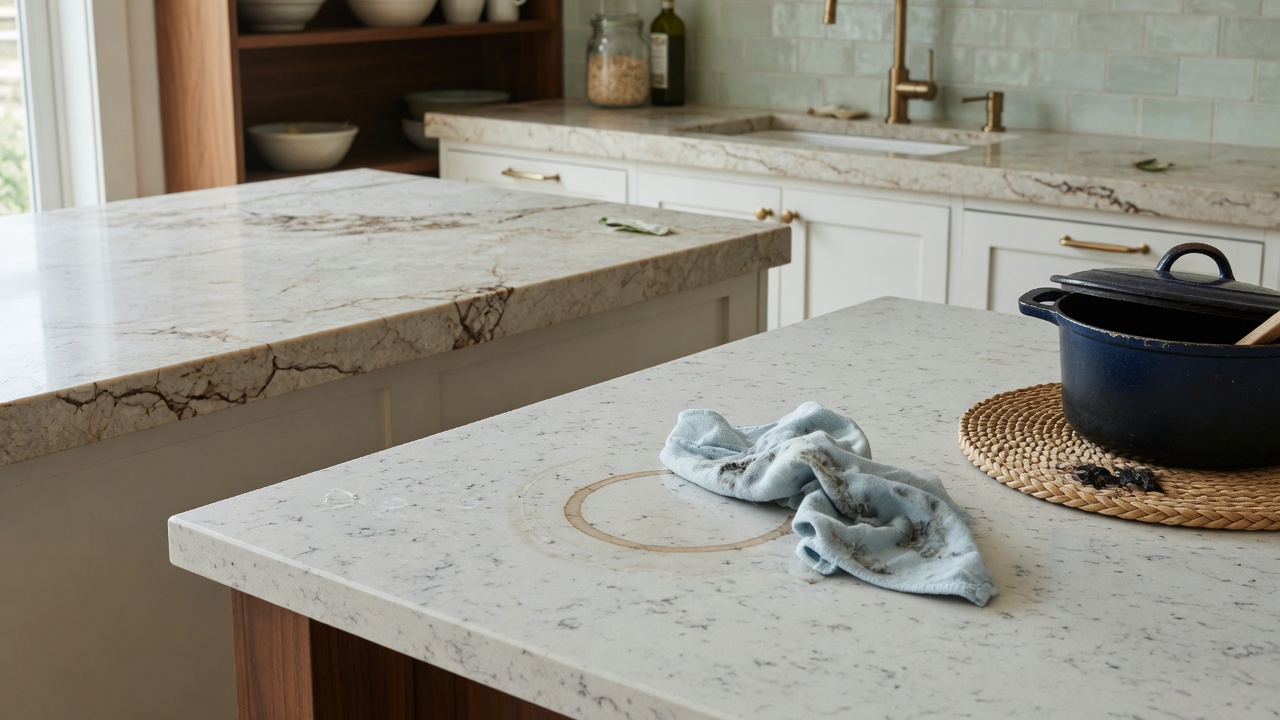
Heat is the one spot where quartz needs real respect. It's engineered with resin, and resin doesn't like sudden high heat. A hot pan straight off the stove can scorch or discolor the surface, sometimes permanently. Always use a trivet or hot pad on quartz. This isn't a knock on the material, it's just a different rule than granite or quartzite, and it's the one homeowners forget most often.
Sun and outdoor use
Quartz isn't a good fit for a sunny outdoor kitchen or a spot that gets direct, long-term sunlight through a big window. The resin can discolor or warp over time with UV exposure. Natural stone handles sun better. If you're building outdoors, we'll usually steer you toward granite instead.
What it costs
Roughly speaking, quartz runs somewhere in the neighborhood of 55 to 90 dollars per square foot installed, depending on the line and edge work, though premium designer collections go higher. That's comparable to mid to upper-range granite and often less than the rarer quartzites. Ask your fabricator for a firm quote on the specific slab you like, since pricing swings by brand and color.
Who it suits
Quartz is a strong pick for a busy family kitchen where spills happen daily and nobody wants to think about resealing. It's also a good call if you want a specific, repeatable look across a large kitchen, or if you're matching an existing quartz counter somewhere else in the house. Renters-turned-owners and anyone who just wants predictable upkeep tend to be happy with it.
Who might look elsewhere
If you love the idea of a slab that's genuinely one of a kind, with movement and depth that came from the earth and not a factory, quartz will feel a little flat next to granite or quartzite. If you cook with cast iron and move hot pans around fast, or you're building near a window with strong afternoon sun, natural stone is the safer choice.
Coming to see it
Photos and small samples never tell the whole story on quartz, the pattern reads differently across a full slab than it does on a nine-inch chip. Stop by our shop at 2015 Charleston Hwy in Cayce and stand next to a few full slabs. Bring your cabinet color and a photo of your kitchen, and we'll help you figure out if quartz is the right fit or if you should be looking at stone instead.