
Local
Engineered quartz countertops for Lugoff homes
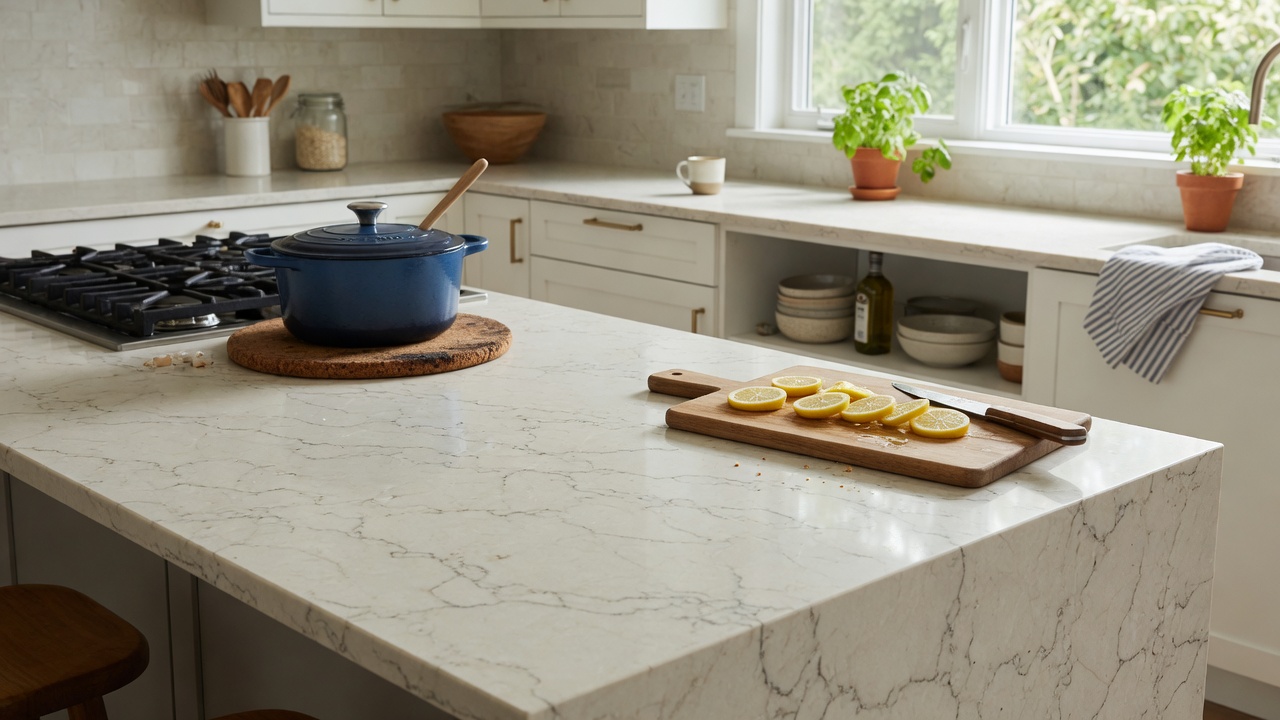
Lugoff has grown fast over the last several years, and we see it in our shop traffic. New construction off Highway 1 and US-1, remodels around Lake Wateree, additions in the older neighborhoods closer to Camden. A good chunk of that work ends up being a countertop question, and quartz comes up in almost every one of those conversations.
We're a family shop out of Cayce, and we cut and install for folks all over the Midlands, Lugoff included. This post is meant to answer what people actually ask us at the slab yard, not sell you on one thing over another.
What engineered quartz actually is
Quartz countertops aren't a solid slab of quarried stone. They're made from crushed natural quartz mixed with resin and pigment, then pressed into slabs. That's why you get consistent colors and patterns that don't exist in nature, like solid whites or deep blacks with no veining at all.
Because it's engineered, not quarried, quartz is non-porous. That one fact drives most of the differences you'll read below.
Quartz vs. natural stone: a fair comparison
Sealing and maintenance
- Quartz: non-porous, no sealing needed, ever. Wipe it down and move on.
- Granite and quartzite: porous to some degree, need sealing at install and then resealing periodically, usually about once a year for a busy kitchen.
- Marble: same sealing needs as other natural stone, plus it etches (more on that below).
If you want the lowest-maintenance option day to day, quartz wins this category clearly.
Heat
- Quartz: the resin in it means a hot pan straight off the stove can scorch or discolor the surface. Always use a trivet.
- Granite and quartzite: handle brief contact with a hot pan better than most surfaces, but we still tell every customer to use a trivet or hot pad. No countertop should take a pan straight off a burner as a habit.
This is one place natural stone has a real edge, though we don't want anyone treating any countertop as a stovetop.
Scratch resistance
- Quartz: resists scratching well for daily kitchen use.
- Quartzite: one of the hardest stones we work with, resists scratching even better than marble.
- Marble: softer, scratches more easily.
Across the board, use a cutting board. It protects your knives as much as it protects the counter.
Stains and etching
- Quartz: non-porous surface resists staining well, and there's no etching since there's no calcite in it to react with acid.
- Granite and quartzite: resist staining when sealed, but a spill left sitting overnight, wine, oil, citrus, can still leave a mark. Wipe it up.
- Marble: etches from acids like lemon juice and vinegar. That dull spot is a chemical reaction, not dirt, and sealing doesn't stop it. A lot of people end up loving that soft, worn look on marble over time. Others don't. Worth knowing before you commit.
Look and consistency
- Quartz: very consistent from slab to slab, which matters if you're matching a large island or doing a whole-house project with multiple rooms.
- Natural stone: every slab is different. That variation is the whole appeal for a lot of people, but it means what you see in the yard is what you get, and no two kitchens look quite the same.
Cost
Both run in a similar rough range installed, generally somewhere around 50 to 100 dollars per square foot depending on the specific material, edge work, and job complexity. Quartz doesn't automatically cost more or less than granite or quartzite. Pricing depends more on the specific slab you pick than the category it falls into.
Who each option suits
Quartz makes sense if:
- You want one less thing to think about long-term (no sealing).
- You're doing a rental property, a busy family kitchen, or a bathroom vanity where low maintenance matters more than natural variation.
- You like a very clean, uniform look, especially solid colors or subtle patterns.
- You're matching a large countertop and want every piece to look the same.
Natural stone makes sense if:
- You want the one-of-a-kind veining and depth that only comes from quarried rock.
- You're comfortable with an annual reseal as routine maintenance, the same way you'd think about resealing a deck.
- You like the idea of a surface that ages and develops character, particularly with marble.
- You're building or renovating a home you plan to stay in a long time and want the resale story of real stone.
What Lugoff homes tend to ask for
A lot of newer construction we see from the Lugoff and Elgin area leans toward quartz for kitchens, especially in homes with open floor plans where the island is a focal point and needs to look identical on every visible edge. Older homes and lake houses being renovated more often go toward granite or quartzite, especially when the owners want something that feels more custom to that specific house.
Neither choice is wrong. It comes down to how you live in the kitchen and how much you want to think about maintenance versus how much you want a surface that's genuinely unique.
Come see both in person
Photos and product pages only tell you so much about color and pattern. If you're planning a kitchen or bath in Lugoff, stop by our shop at 2015 Charleston Hwy in Cayce. We keep both quartz and natural stone slabs on hand, and we're happy to walk you through the real differences with actual material in front of you, not just a sample chip.