
Buying guides
Picking the right engineered quartz slab: color and veining questions worth asking
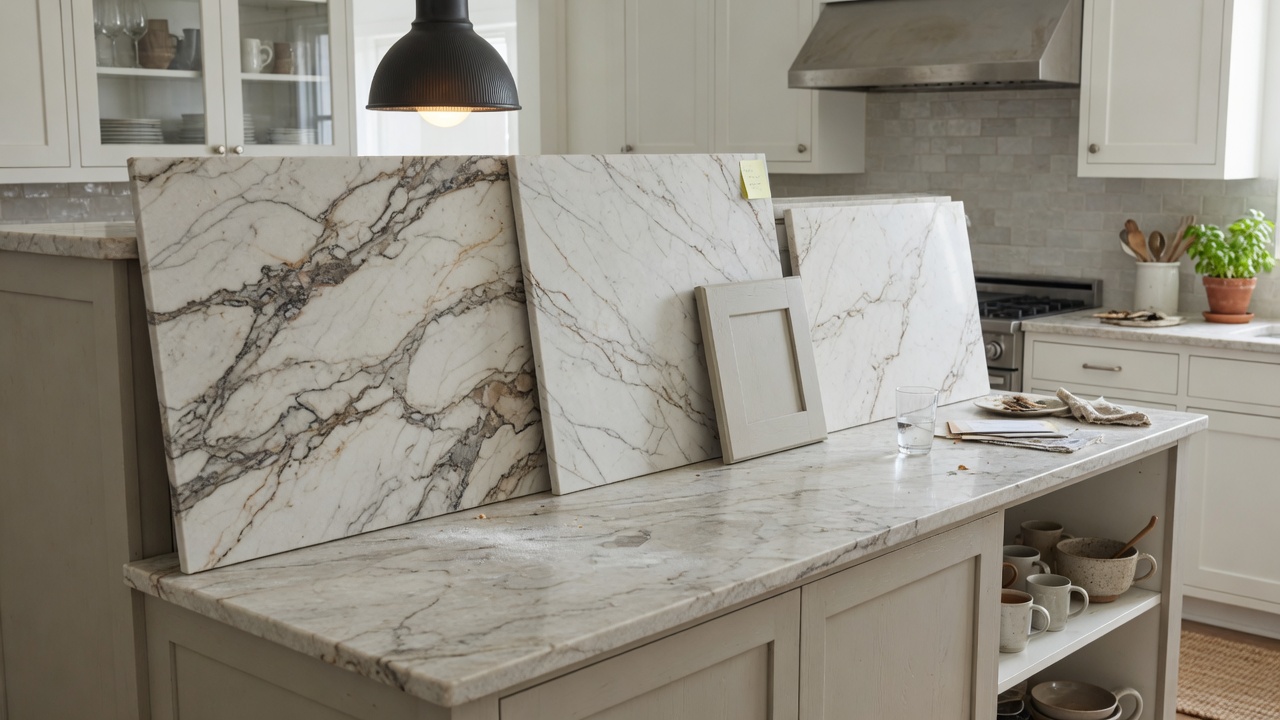
Why does the quartz in the showroom look different from the sample chip?
A sample chip is maybe 4 inches square. A slab is 9 or 10 feet long. Veining patterns that look bold and dramatic on a small chip can either spread out nicely across a full slab or bunch up in a way you didn't expect. Quartz manufacturers design their patterns to repeat and blend, but the only way to really know how a color reads at full size is to look at an actual slab, not just the sample board. We keep full slabs on the floor for this reason. Stand back from it the way you'd stand at your island, not two inches away like you're reading a menu.
Will my slab look exactly like the one I picked out?
Mostly yes, but not pixel for pixel. Engineered quartz is manufactured, so it's far more consistent than natural stone from slab to slab. Still, quartz is made in batches, and dye lots can shift slightly over time. If your job needs more than one slab, ask us to pull them from the same lot number. We check that before we cut. It's a small thing that saves a headache later, especially on a big island with a seam.
Should I match the veining to my cabinets or contrast it?
There's no single right answer, but here's how we think about it. If your cabinets already have some visual movement (wood grain, a two-tone kitchen, patterned tile), a quieter quartz with subtle veining usually looks calmer and doesn't compete. If your cabinets are a solid flat color, especially white, gray, or navy, a quartz with more distinct veining gives the kitchen something to look at. We've watched customers walk in dead set on a bold veined slab and change their mind once they hold it against their cabinet door in person. That's why we ask people to bring a door or a paint chip if they can.
Does lighting change how the slab looks?
It changes it more than most people expect. Warm LED bulbs pull out the beige and gold undertones in a slab. Cool white bulbs make the same slab look grayer and flatter. Natural daylight from a window shows the truest color, but most of us use our kitchens at night under artificial light too. If you can, look at the slab in our showroom under a few different light sources, and if you're able to bring a photo of your kitchen's actual lighting, that helps. What looks perfect under showroom lighting can shift once it's under your fixtures at home.
Why do some quartz slabs cost more even though they're the same brand?
Within one manufacturer's line, price usually tracks how complicated the pattern is to produce. A plain white or solid gray quartz is simpler to manufacture consistently. A slab designed to mimic marble veining, with layered color and movement, takes more work to get right and costs more per square foot. Neither one is