
Buying guides
Natural stone vs engineered stone: the real difference
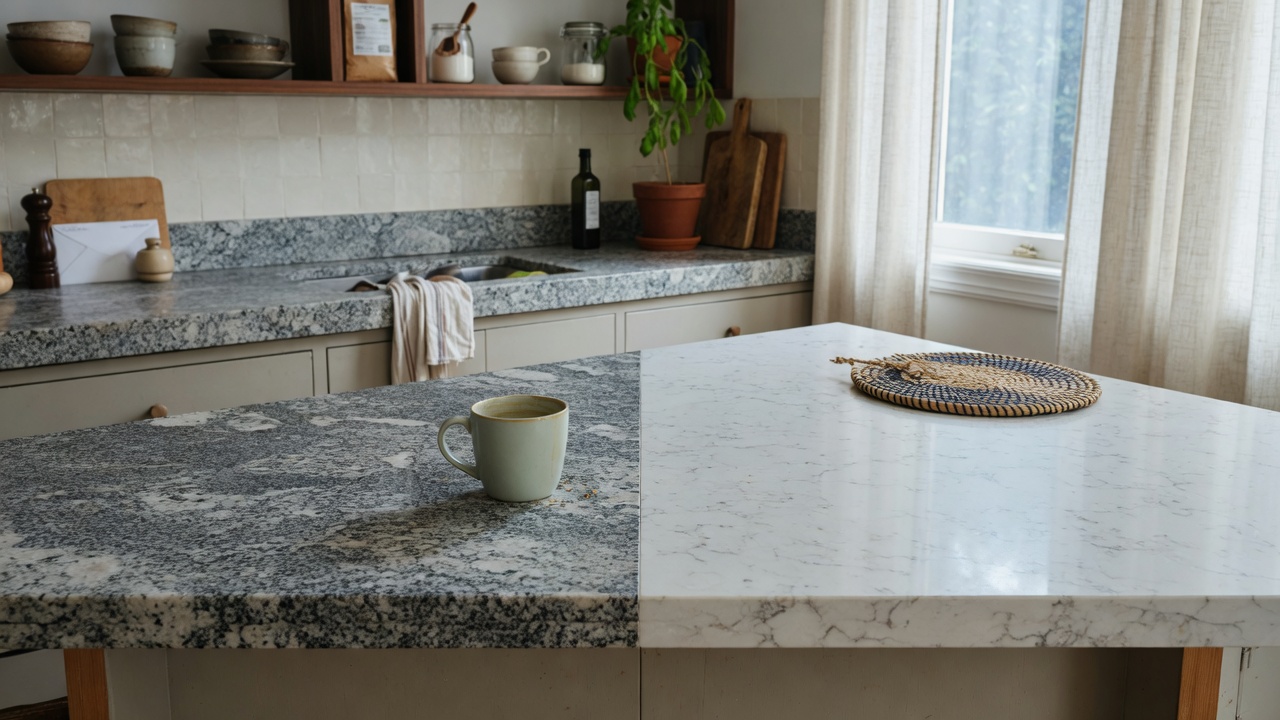
Myth: it's basically the same rock, just different names
We hear this a lot at the slab yard. Someone points at a granite slab, then a quartz sample, and asks what's really different besides the price tag. They're not even made the same way, and that one fact drives almost everything else about how they act in your kitchen.
What natural stone actually is
Granite, marble, quartzite, and soapstone are quarried. They're cut whole out of the ground, somewhere in Brazil, Italy, India, or a handful of other spots around the world, and shaped into slabs. Every slab is one piece of the earth. That's why no two slabs match exactly, why veining runs a certain direction, and why a mineral fleck in one corner might not show up anywhere else in the whole block.
Because it's a natural material, it's also porous to some degree. Granite and quartzite are on the harder end and resist scratching better than marble, but even they can scratch, so we still recommend a cutting board. And because it's porous, natural stone should be sealed and resealed periodically, usually about once a year for most kitchens.
What engineered stone (quartz) actually is
Quartz countertops aren't quarried as a solid slab. They're manufactured: crushed quartz stone, ground down to something close to sand, gets mixed with pigments and a polyester resin, then pressed and cured into a slab. That resin is the whole story. It's what makes quartz non-porous, so it doesn't need sealing at all. It's also what gives quartz its very consistent, repeatable pattern, which is why you can order the same look for a big kitchen and have every slab match.
But the resin is a plastic, and plastic doesn't like heat. A hot pan can scorch or discolor a quartz counter in a way granite usually handles better. Always use a trivet on quartz. That's not a knock on the product, it's just physics: resin softens or burns before quartz's mineral content ever would.
Myth: engineered stone is maintenance-free
You'll hear that quartz never needs any care at all because it doesn't need sealing. It's true you can skip the sealer, but quartz still wants a trivet under hot pans and a cutting board under knives. Skip both and you'll eventually see a scorch mark or a scratch in the surface, resin included.
Myth: natural stone is fragile and hard to live with
On the other side, people worry granite or quartzite will stain or crack if you look at it wrong. In practice, granite and quartzite are tough, everyday countertops. They handle brief contact with a hot pan better than most surfaces (still use a trivet), and a good seal at install, plus a yearly reseal, keeps them resisting stains just fine for normal kitchen life. Marble is the one that needs a little more respect, since it etches (dulls) from lemon juice, vinegar, and other acids. That's a normal trait of marble, not a flaw, and plenty of people love the look enough to live with it.
So which one should you pick?
There's no universal right answer. If you want one-of-a-kind veining and don't mind a yearly reseal, natural stone is hard to beat. If you want a very consistent pattern with no sealing to think about, and you're careful about trivets, quartz makes sense. Both are good countertops when you understand how each one actually behaves.
Come by our shop at 2015 Charleston Hwy in Cayce and we'll walk you through slabs of both kinds side by side. Seeing granite next to quartz in person makes the difference click a lot faster than any explanation can.