
Stone, straight
Myth: you can set a hot pan on any stone countertop
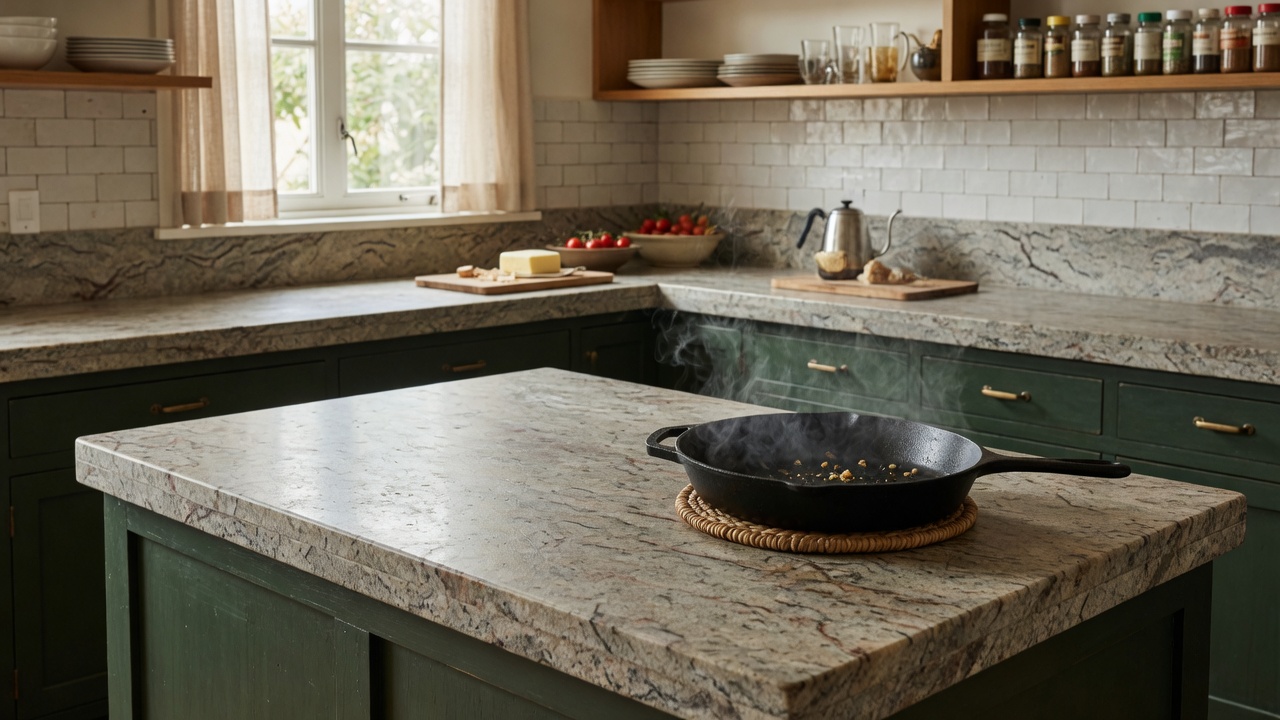
The myth
You'll hear it in every showroom and half the home renovation shows: stone countertops are heatproof, so go ahead and pull that cast iron skillet straight off the burner and set it down. We hear a version of this almost every week at the shop. Someone's had granite for ten years and never had a problem, so they figure any stone will act the same way.
It's not that simple, and the difference matters enough that we want to walk through it slab by slab.
What granite and quartzite actually do
Granite and quartzite are both formed under heat and pressure underground, so they handle brief contact with a hot pan better than most kitchen surfaces. A pot straight off the stove for a few seconds usually isn't going to hurt either one.
That's not the same as saying they're heatproof. Sudden temperature swings, like setting a pan down on a cold counter on one spot over and over, can stress the stone over time. Some quartzite slabs also have resin fillers or fissures that behave differently under heat than the solid rock around them. We can't promise how every individual slab will react, because no two are identical.
Our answer is simple: use a trivet or a hot pad every time. It costs you nothing and it protects a surface you paid good money for.
What quartz does, and why it's different
Quartz countertops are engineered, not cut from a single block of rock. They're made from crushed stone bound together with resin, usually somewhere around 90 to 95 percent stone and the rest polymer resin. That resin is what gives quartz its consistent color and pattern, and it's also its weak point around heat.
Resin can scorch, discolor, or even crack under a hot pan in a way that solid granite or quartzite won't. We've seen quartz counters with a dull ring burned right into the surface where someone set down a stockpot after boiling pasta. It's not reversible like wiping up a spill. Once that resin scorches, the mark is there for good.
If you have quartz in your kitchen, treat trivets as non-negotiable, not optional. That includes pans straight off the stove, crockpots left running, and even hot baking sheets fresh out of the oven.
So which stone is safest around heat?
Here's the comparison, in plain terms:
| Stone | Heat tolerance | Our recommendation |
|---|---|---|
| Granite | Handles brief heat well | Trivet every time |
| Quartzite | Handles brief heat well | Trivet every time |
| Quartz | Resin can scorch or discolor | Trivet every time, no exceptions |
| Marble | Handles brief heat but etches easily from other things | Trivet every time |
Notice the recommendation column doesn't change. That's on purpose. Even on the toughest stone we sell, we're not going to tell a customer it's fine to skip the trivet. "Handles heat better than most" isn't the same promise as "nothing will ever happen." We'd rather undersell it and have your counter look perfect in fifteen years than oversell it and have you disappointed the first time something goes wrong.
A few habits that actually protect your counter
- Keep a trivet or hot pad by the stove and by wherever you set pans down after cooking.
- Let cast iron cool for a minute or two before it touches any countertop, stone or otherwise.
- Don't set a slow cooker or instant pot directly on the counter for hours at a time. Even low, steady heat over a long stretch is a different situation than a quick set-down.
- If you're not sure what stone you have, ask us. Some slabs sold under one name behave more like another, and knowing what's actually in your kitchen changes how careful you need to be.
Come see it for yourself
We keep sample pieces at the shop specifically so people can see the difference between granite, quartzite, and quartz up close, including how each one takes a shine, a scratch test, and yes, a little heat. Choosing a stone for a kitchen that sees a lot of cooking is a conversation worth having before you buy, not after. Stop by 2015 Charleston Hwy in Cayce and we'll walk through it with you, slab in hand.