
Buying guides
Is marble worth it for a kitchen?
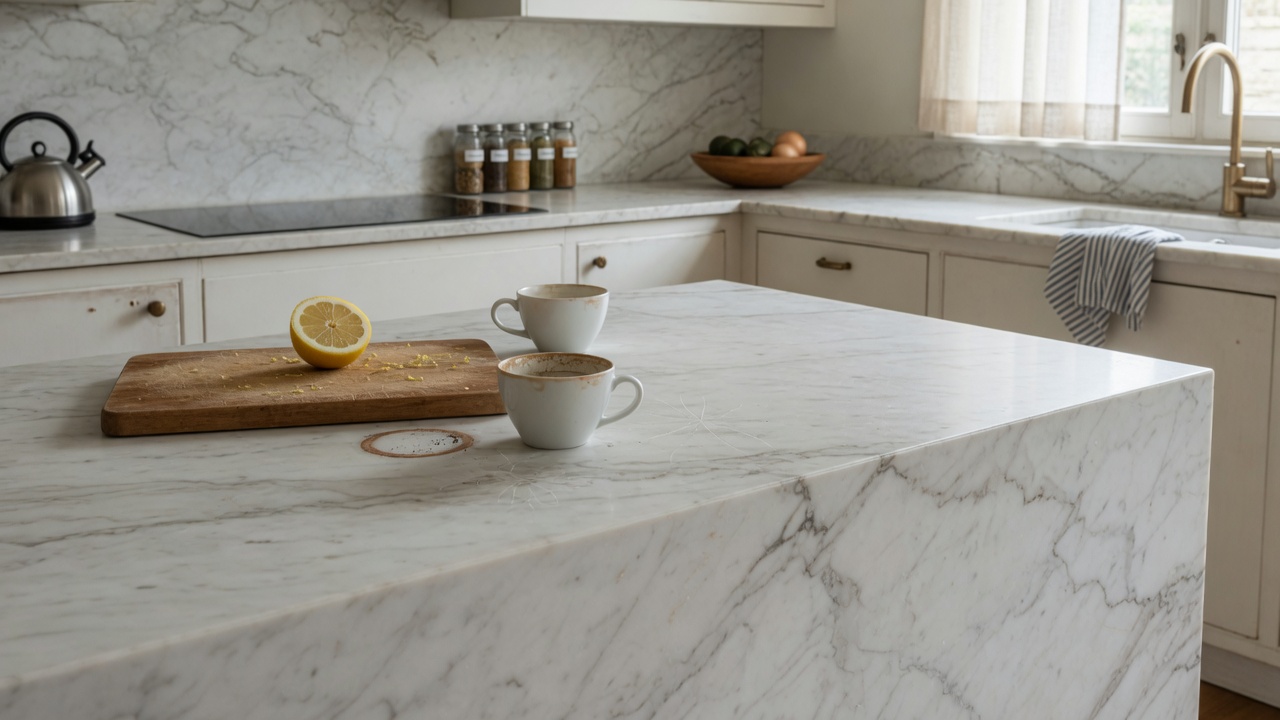
The myth: marble is too fragile for a real kitchen
You'll hear this one from a lot of people who never lived with it: marble is too soft and too delicate for a working kitchen, so nobody should put it near a stove. That's an overstatement, and it skips over what marble actually does well and where it actually struggles. Let's get into the real version.
What marble actually does well
Marble is calcite stone, and it's been used on counters, floors, and altars for a couple thousand years for a reason. The veining is real, not printed, and no two slabs look alike. If you want a kitchen that looks like it belongs in an old European bakery or a bright, quiet bath, marble does that better than almost anything else we sell. It also stays noticeably cooler than granite or quartz, which is part of why bakers love it for rolling dough.
The real correction: marble etches, and that's normal
Here's the part that trips people up. Marble etches. Lemon juice, vinegar, tomato sauce, even a splash of wine left too long will leave a dull spot on the surface where the acid reacted with the stone. Sealing helps the stone resist staining, but it doesn't stop etching. That's a chemical reaction on the calcite itself, and no sealer blocks it.
A lot of our customers who go with marble learn to think of those marks as part of the stone's character, the way a wood cutting board picks up its own history. Some kitchens even develop a soft patina over the years that people like. If the idea of a permanent dull ring near the stove bothers you, marble might not be the right fit, and that's worth being honest about before you buy.
Where it holds up, and where it needs help
Marble is a working stone, not a fragile one, but it needs a few habits:
- Wipe up citrus, wine, and vinegar as soon as they spill. Sitting overnight is when stains and etch marks get worse.
- Use a cutting board every time. Marble is softer than granite or quartzite and resists scratching less well than those stones, so knives and kitchen tools can mark the surface if you set them straight on it. A cutting board protects both the stone and your knife edges.
- Use a trivet for hot pans. Marble handles brief heat reasonably well, but sudden temperature changes can stress any natural stone, so don't risk it.
- Reseal periodically, usually about once a year in a busy kitchen. It's porous like other natural stone, and sealing buys you time against spills.
Cost and who it suits
Marble usually runs somewhere in a similar range to other natural stones, roughly 50 to 100 dollars per square foot installed depending on the specific slab and edge work, though the showier veined slabs can run higher. That's a rough range, not a quote, and it moves with slab choice and job complexity.
Marble suits people who love the look enough to accept the marks that come with real life, people doing a bar, powder room, or island where cooking acid isn't a daily risk, and people who don't mind a little maintenance rhythm. It's a tougher sell for a family that cooks with a lot of citrus and tomato and wants a surface that looks brand new for a decade without any babying. For that kitchen, granite or quartzite often makes more sense, and quartz if low maintenance matters most.
If you're on the fence, come look at a few marble slabs next to granite and quartzite side by side at our shop at 2015 Charleston Hwy in Cayce. Seeing the veining and feeling the surface in person tells you more than any spec sheet.