
Care and maintenance
Sealing marble: when to do it, how often, and the water test that tells you
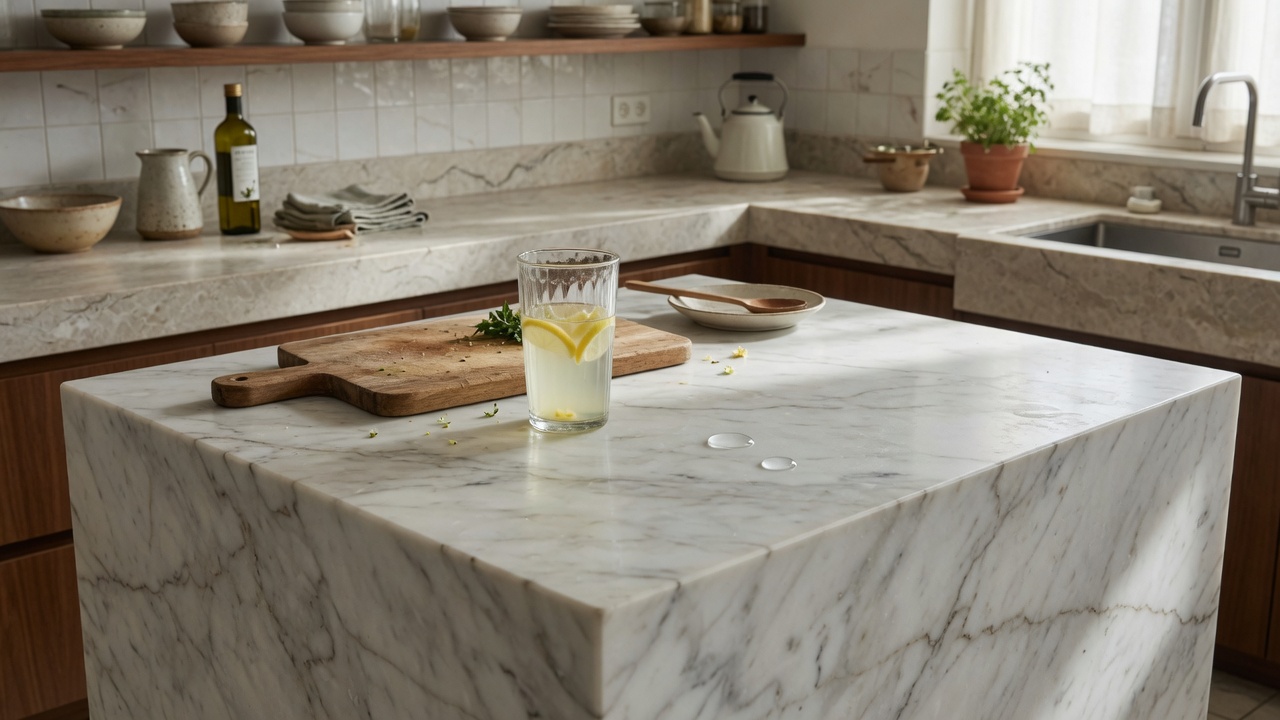
Marble gets a lot of questions in our showroom, and most of them come down to one thing: how do you take care of it. Sealing is part of the answer, but it's only part. Here's what sealing does, what it doesn't do, and how to know when it's time to do it again.
We seal every marble countertop at install with a quality penetrating sealer, applied by installers we train to do it right. That first seal, the one that matters most, is done for you before you ever start cooking on it. After that, it's on a schedule.
What sealing actually does for marble
Marble is a calcite stone, and like granite and quartzite, it's porous to some degree. A sealer sits in those pores and makes it harder for liquids to soak in and stain. That's it. That's the job.
- Sealing resists stains. It buys you time to wipe up a spill before it sets in.
- Sealing doesn't stop etching. Etching is a chemical reaction between acid (lemon juice, vinegar, wine) and the calcite in the stone. No sealer on the market stops that reaction. If you want a surface that handles acids better, you want granite or quartzite, not marble.
- Sealing doesn't change how the stone looks or feels. A good penetrating sealer is invisible. If your marble suddenly looks shiny or plasticky after sealing, something was applied wrong or it's a topical product, not a true penetrating sealer.
The water test: how to check if it's time to reseal
You don't have to guess or reseal on a fixed calendar if you don't want to. There's a simple test that tells you where your marble stands.
How to do it:
- Pour a small puddle of water, about the size of a quarter, onto a clean, dry section of the countertop. Pick a spot you use often, near the sink or stove, since those wear faster.
- Let it sit for 10 to 15 minutes without touching it.
- Look at what the water did.
What it means:
- If the water beads up and sits on top, your sealer is still doing its job. No need to reseal yet.
- If the water soaks in and darkens the stone, or spreads out and leaves a damp ring, the sealer has worn thin in that spot and it's time to reseal.
- If it's somewhere in between, a slow soak rather than a bead, that's an early sign. You've got some time, but don't wait too long.
Run this test every few months if you're not sure of your schedule. It takes two minutes and it's the most honest read you'll get, better than guessing by the calendar alone.
A realistic reseal schedule
Every kitchen wears differently, so treat this as a starting point, not a rule:
- Busy kitchen, marble island or prep zone: check every 6 months, reseal when the water test says so, often once a year.
- Lighter-use kitchen or a marble bathroom vanity: once a year is usually plenty, sometimes every 18 months.
- Marble backsplash or a rarely-touched surface: can often go longer between seals since it's not taking spills or heavy traffic.
Humidity, how often you clean with harsh products, and how much cooking acid (tomato sauce, citrus, wine) touches the surface all speed up how fast a sealer wears down. If you cook a lot of red sauce and citrus dishes, lean toward the shorter end.
Marble vs. quartz: who needs to think about sealing at all
Since this comes up constantly when people are choosing a stone, it's worth laying out plainly.
Marble (and other natural stone):
- Porous, needs sealing, benefits from resealing over time.
- Etches from acids. That soft, dulled patina is part of how marble ages and isn't a defect, but it does mean lemons and wine glasses left too long will leave a mark.
- Rewards a little routine care: wipe spills, reseal on schedule, use a cutting board.
- Suits someone who loves the look and the aging character of marble and doesn't mind a bit of upkeep.
Quartz:
- Engineered with resin, non-porous. It doesn't need sealing.
- Resists staining and etching better than marble because there's no open pore structure and no calcite to react with acid.
- The tradeoff: quartz isn't a great match for hot pans either. The resin can scorch or discolor from direct heat, so a trivet is still a must.
- Suits someone who wants a lower-maintenance surface and a more uniform, manufactured look rather than natural veining and variation.
Neither one is the wrong choice. It comes down to how you use your kitchen and how much upkeep you're willing to do. If you want to see how marble and quartz actually look and feel side by side, stop by 2015 Charleston Hwy in Cayce. We're happy to walk through both with you and help you figure out what fits your household.