
The work
How we template and fabricate marble countertops
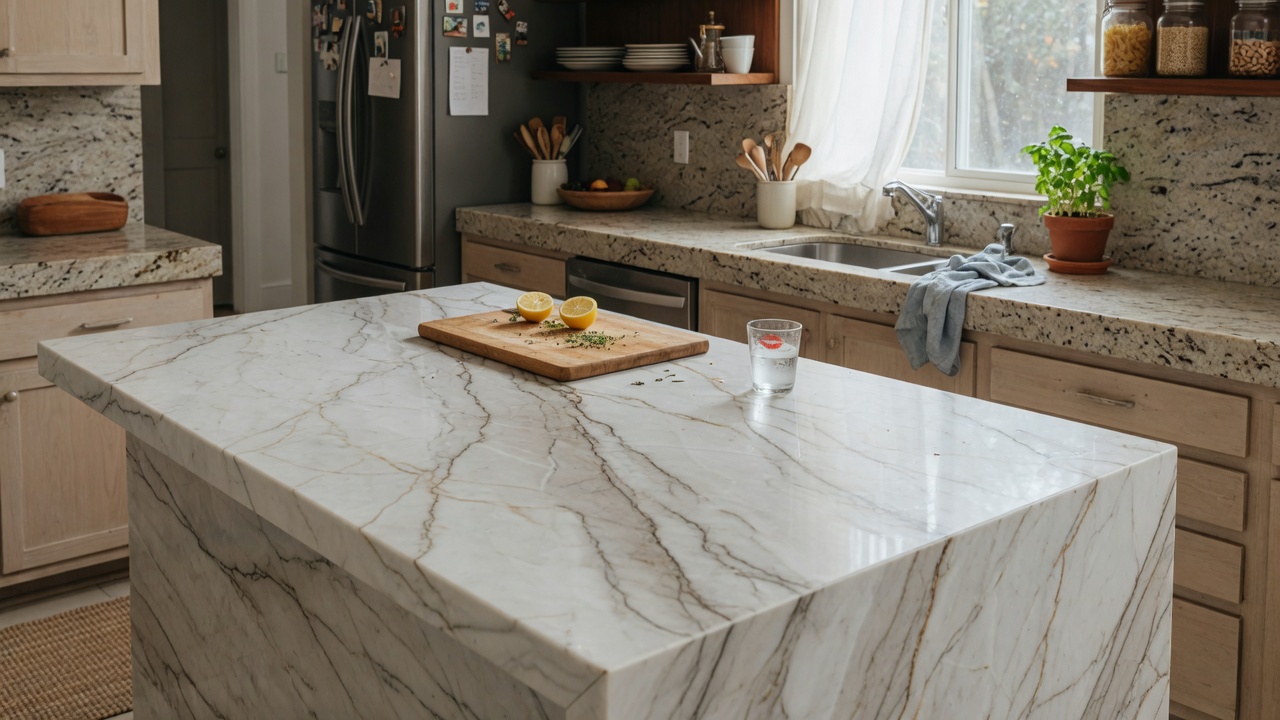
What actually happens before your marble gets cut
Once you pick a slab, we don't just measure your cabinets and send it to the saw. We come out to your house with a digital templating tool that maps your actual cabinet boxes, walls, and any out-of-square corners (and there are always a few). That template becomes the exact cutting pattern for your slab, not a generic rectangle. It's the step that keeps a $200 mistake from turning into a $2,000 one.
Why we lay the slab out before we cut
Marble isn't uniform. Every slab has movement in it, veining that runs a certain direction, spots where the background color shifts a shade, sometimes natural fissures that are just part of the stone. Before anything gets cut, we lay the template on the actual slab and walk through where the veins will land on your island, your cooktop area, your sink run. We want the veining to flow in one direction across the whole kitchen when we can manage it, and we want the most dramatic movement in the spot you'll actually see, not hidden under an overhang.
Why seams land where they land
Nobody loves a seam, but slabs come in finite sizes, usually somewhere around 9 to 10 feet long depending on the quarry. If your run is longer than that, a seam is unavoidable. We put it where it's least noticeable and structurally sound, often just off to one side of a sink or cooktop rather than dead center, and we try to place it along a vein line so it reads as part of the stone's pattern instead of a break in it. A well-placed seam on marble, matched for color and veining, is close to impossible to spot from a few feet away.
Cutting and finishing the edges
Once the layout is set, the slab goes to the saw, usually a CNC-guided cut for the straight lines and cutouts (sink, cooktop, outlets), with edge profiles like eased or bullnose shaped and polished by hand or on the edge machine. Marble is softer than granite or quartzite, so we cut it slower and are more careful about chipping at corners and cutout edges. Polishing brings out the shine and the depth in the veining, which is honestly one of the best parts of the whole process, watching a honed slab come up glossy.
Sealing and setting it in your kitchen
Before install, we seal every marble top with a good sealer, done by installers we train to apply it right. That's part of the job, not an upsell. Marble is porous, so sealing helps it resist stains, though it won't stop etching from lemon juice or vinegar; that's a chemical reaction with the calcite in the stone, and sealer doesn't touch it. That soft, occasional etch mark is just part of owning marble, not a flaw in the install.
If you want to see how veining moves across a few different marble slabs before you commit, come by 2015 Charleston Hwy in Cayce. Seeing it in person under real light tells you more than any photo will.