
Buying guides
How to pick a marble slab: reading color and veining before you buy
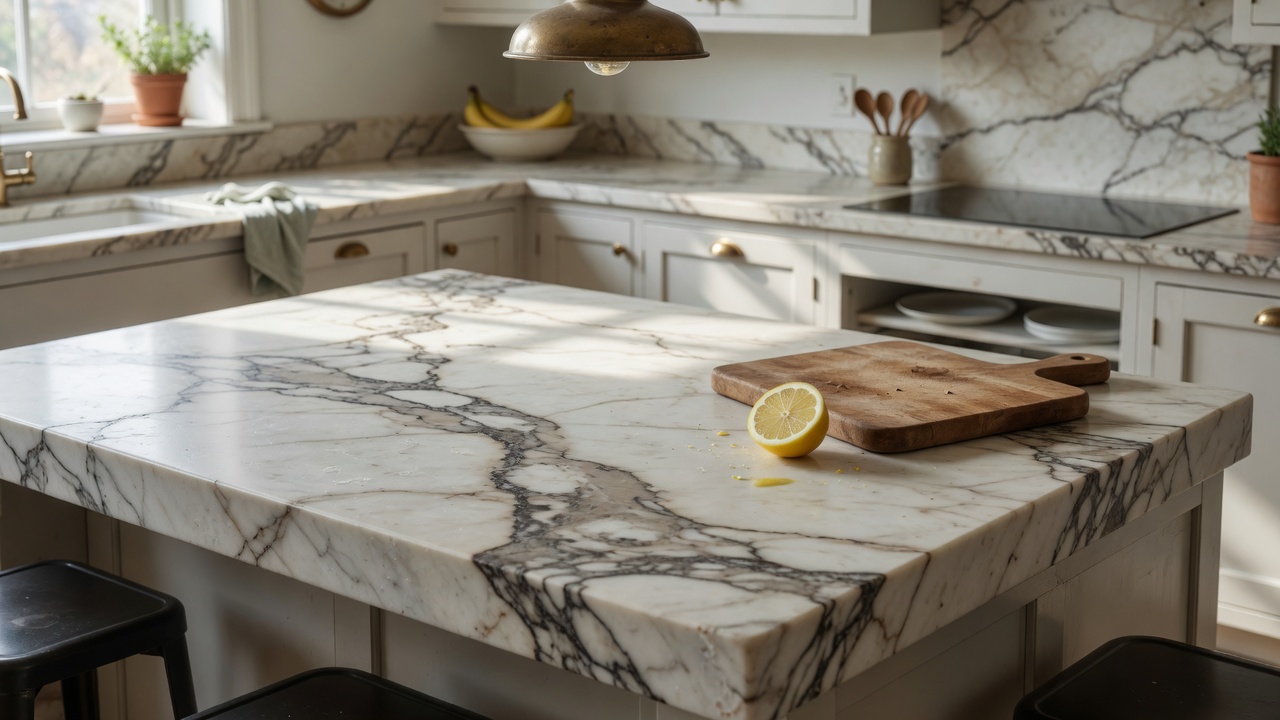
Marble is the least predictable stone we carry, and that's part of why people love it. No two slabs read the same way, even from the same quarry block. Here's how we walk customers through picking one.
Look at the whole slab, not a sample chip
A 4x4 inch sample tells you almost nothing about a marble slab. Veining moves across a slab in bands, clusters, and open fields of plain background color. A chip might catch a heavy vein zone or a quiet spot, and either one can mislead you about what you're actually buying. Always ask to see full slabs, and if you can, see the exact one that will end up in your kitchen.
Background color matters as much as the veining
People fixate on the veins and forget the field color around them. Marble backgrounds run from bright white to warm cream, soft gray, or even greenish and pink casts depending on the quarry. That base color is what you'll live with day to day, since it covers more square footage than the veins do. Hold it next to your cabinet doors and flooring sample, not just a paint swatch, before deciding.
Understand why slabs from the same block still differ
Slabs are cut in sequence from one quarry block, and even neighboring slabs can look noticeably different once you get a few cuts apart. That's just how the stone formed, with mineral bands running through it unevenly. If you love a specific slab, ask whether its immediate neighbor is available too. That's your best shot at a close match for a large island or a countertop that needs to flow across a seam.
Decide how busy you want the veining
Veining ranges from thin, quiet lines to bold, dramatic movement that reads almost like ink dropped in water. Neither is more correct, but they behave differently in a room. Busy veining draws the eye and works well as a statement, especially on an island. Calmer veining recedes and lets cabinetry, tile, or a bold faucet finish take the lead. Think about what else in the room is already competing for attention before you pick a heavy slab.
Check the slab under your own lighting, not just showroom lights
Showrooms use bright, even lighting that can wash out warmth or flatten depth in a slab. Your kitchen probably has warmer bulbs, task lighting under cabinets, and natural light that shifts through the day. If you can, step outside with the slab or view it near a window. A slab that looks cool and gray under fluorescent light can read warmer and softer at home, and that shift matters more with marble than with almost any other stone.
Match veining direction to your layout
Veining has a direction, and it can be book-matched, run in one continuous flow, or turned to break up a long countertop. Think about how the vein lines will land at your sink, your cooktop, and any seams. A dramatic vein that gets cut awkwardly at a seam or interrupted by a sink cutout can look like a mistake instead of a feature. This is worth discussing with your fabricator before the slab gets cut, not after.
Remember that the name on the slab isn't the whole story
Some stones sold under a marble name are labeled more by tradition than strict geology, and the reverse happens too, with calcite stones sold as something else. What actually matters is how the stone behaves: does it etch from acid, how hard is it, how does it polish. Ask your fabricator to walk you through the specific slab in front of you rather than relying on the name on the tag.
Plan for the patina, not just the picture
Marble etches when it meets something acidic, like lemon juice or vinegar, and that dulls the polish in small marks over time. It's normal, not a defect, and a lot of people come to like the softened, lived-in look a marble counter develops over years. But if you want the surface to look exactly like day one indefinitely, that's not how marble works, so factor that into your decision now rather than being surprised later.
See it in person before you sign off
Photos and even video calls compress color and flatten veining detail. Marble has depth to it, sometimes almost translucent in spots, and that quality doesn't come through on a screen. If you're picking a slab for a big investment like a kitchen, come look at it in daylight, run your hand over it, and stand back to see how the veining reads at a distance, not just up close.
If you're in the Midlands and want to see marble slabs in person, come by our yard at 2015 Charleston Hwy in Cayce. Bring a cabinet door sample or a photo of your kitchen, and we'll help you figure out what actually works in your space.