
Stone, straight
How we measure and cut your countertops, from laser template to CNC
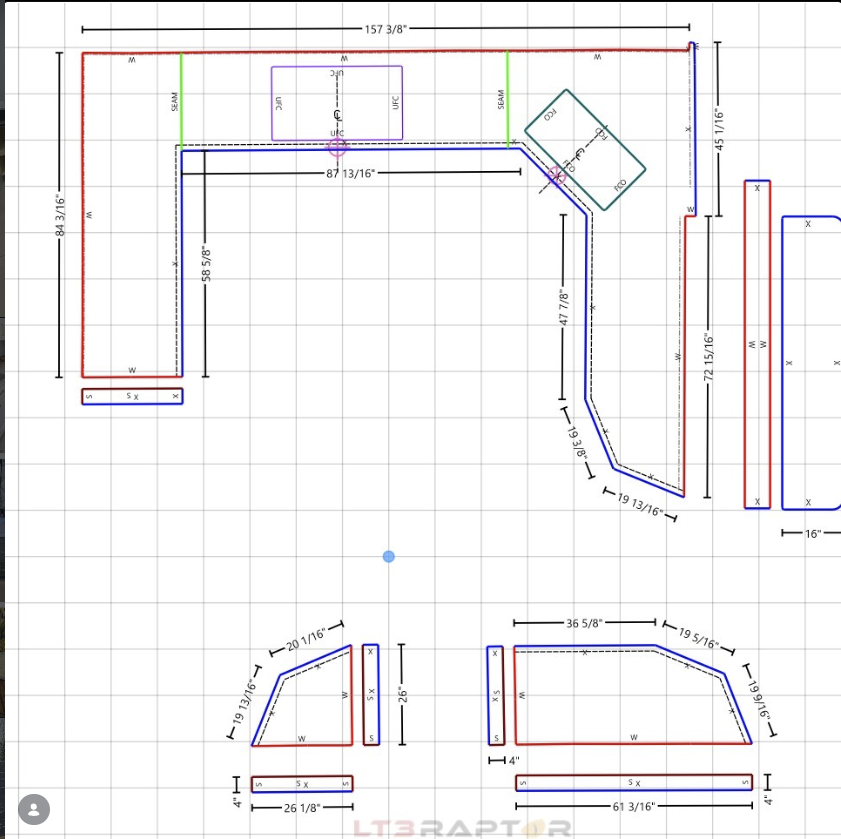
People ask me about this more than almost anything else. You're trusting a piece of stone that costs real money to fit your kitchen within a fraction of an inch, and you want to know how we actually get there. Here's how it works, question by question.
Do you still measure with a tape measure?
No, not for the final template. We use a Laser Products LT2D3D with Raptor technology. It's a digital measuring tool that shoots laser points around your cabinets, walls, and openings and builds an exact digital map of your kitchen or bathroom, corners, out of square walls, sink cutouts, cooktop openings, all of it. A tape measure is fine for a rough estimate when we first quote the job, but the template that actually drives the cut comes from the laser. It catches things a tape measure misses, like a wall that's a quarter inch out of square over 10 feet, which matters when you're fitting solid stone into a real house that wasn't built perfectly.
What happens to that digital template?
Once we've got the laser data, it turns into a digital layout of your countertop. That layout gets placed right on top of a photo or scan of your actual slab. This is the part I like showing customers most, because you get to see your specific piece of granite, quartzite, or marble with your cabinet lines drawn right on it before we make a single cut. You're not picking a slab out of a rack and hoping for the best. You're seeing exactly what part of that slab ends up on your island, and what part ends up on your perimeter run.
Can I actually see the seam placement before you cut?
Yes, and I think you should. Once we lay your digital template over the slab, we can move it around to decide where a seam falls, if your layout needs one at all. Some kitchens with a big enough slab don't need a seam. Others, especially large islands or L-shaped kitchens, need one, and where it lands matters. We'll show you on screen where we're proposing it, usually somewhere it's least noticeable, like near a sink or a cooktop where the eye naturally breaks. You get to weigh in before it's permanent. You can see how that lands on finished jobs on our kitchen countertops page.
What about vein matching? Can you really control that?
Within the limits of the actual stone, yes. If your slab has strong movement, big veins or dramatic color bands, we can slide the digital layout across the slab image to line up how the pattern flows across a seam, so the veining looks like it continues rather than jumping or mismatching. We'll pull up a couple of options and let you pick which one you like best. I'll tell you straight, natural stone doesn't always cooperate perfectly, veining runs at angles and doesn't always line up exactly the way we want on both sides of a cut. But we get you as close as the slab allows, and you see it before it happens, not after. The Perla Venata quartzite kitchen in St. Matthews is one where that layout work shows.
What actually cuts the stone?
Once the layout is locked in, the file goes to our Sasso K600 XL Extreme, a 5 axis CNC saw. Instead of someone freehanding cuts based on marks, the machine follows your exact digital template, cutting the countertop, sink cutout, faucet holes, and edge profile to the layout we already showed you on screen. Five axis movement means it can angle the blade to cut bevels, ogees, and other edge profiles in the same pass instead of needing separate setups. That's part of why the edges come out consistent from one end of a 10 foot run to the other.
Does this process cost more or take longer?
It doesn't add cost, and it usually saves time compared to the old way of paper templates and hand layout. The laser template appointment typically takes less than an hour, and because the digital file goes straight to the saw, there's less room for the kind of measuring error that used to mean a redo. The main thing it buys you is certainty. You know what you're getting before it's cut, not after it's already in your kitchen. Template day is phase two of our four-phase process, and the rest of it is laid out there start to finish.
Why does this matter to me as a homeowner?
Because a countertop is permanent once it's set. You're not picking paint you can repaint next year. Seeing the seam location and vein match ahead of time means the decisions get made together, with your input, instead of me making a judgment call in the shop and hoping you're happy with it. It's your kitchen, and you should get a say in where the seam lands and which way the veining runs.
If you want to see how this actually looks on a real slab, come by 2015 Charleston Hwy in Cayce. I'm happy to walk through a layout with you on screen before anything gets scheduled. If you'd rather start with a price, send us your project and we'll work one up.