
The work
How countertop templating works, and why it happens after cabinets go in
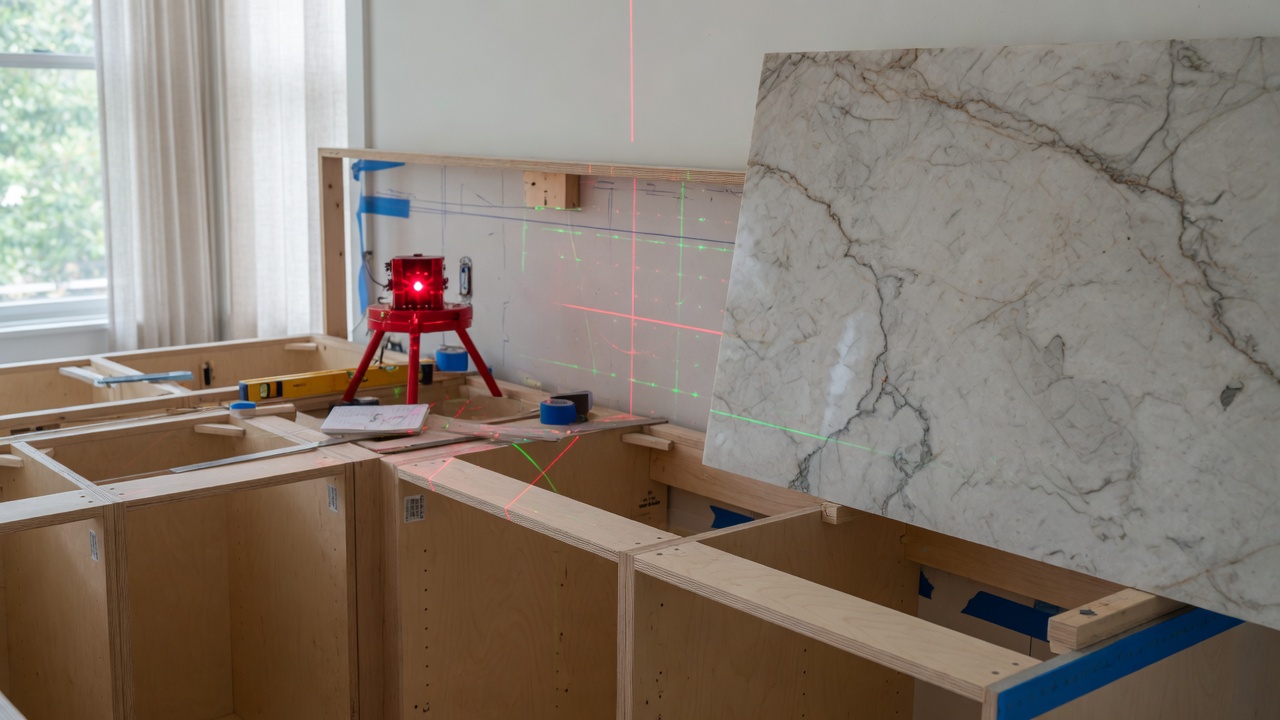
Templating is the quiet part of a countertop job that makes everything after it go smoothly or badly. It's the step where we capture the exact shape of your cabinets, walls, and openings so the slab gets cut to fit your kitchen and only your kitchen. Skip it or rush it, and you end up with gaps at the wall, a sink that doesn't sit right, or seams in the wrong spot.
Why templating happens after cabinets are installed
We don't template off your old countertops, your contractor's drawings, or a floor plan. We template off the cabinets themselves, once they're set in their final position.
Here's why that order matters:
- Cabinets shift during install. A box that's supposed to sit flush against a wall might be a half inch off once it's leveled and shimmed.
- Walls are rarely straight. Older homes especially can be out of square by a noticeable amount over a run of cabinets, and a good template accounts for that instead of assuming everything is a perfect rectangle.
- Appliances need their final spot confirmed. If a range or dishwasher moves an inch during install, that changes the cutout.
- Plumbing and electrical rough-ins need to be in place. We need to know exactly where a faucet hole or outlet has to land.
If we template before cabinets are locked in, we're measuring a kitchen that doesn't exist yet. That's how you get countertops that don't sit flush or overhangs that are uneven from one side to the other.
Digital templating
Most of our jobs today get templated with a laser measuring system. A technician walks the kitchen with a device that shoots laser points around the cabinet edges, walls, and any cutout locations, and builds a digital map of the space.
What it's good at:
- Speed. A full kitchen usually takes well under an hour.
- Precision on straight runs and standard layouts. The laser doesn't drift the way a hand-held tape measure can.
- Sending the file straight to our fabrication saw, which cuts down on transcription errors between the measurement and the cut.
- Handling multiple pieces (island, perimeter, bar top) in one session with consistent reference points across all of them.
Where it has limits:
- Unusual angles or curved cabinet fronts can be trickier for the laser to capture cleanly, and sometimes need a manual double check.
- It's only as good as the technician running it. Someone has to know which points matter and confirm appliance and sink placement by hand regardless of what the laser sees.
Physical templating
The older method, still used on some jobs, especially unusual shapes or tight retrofit situations, involves building an actual physical pattern. That might be thin plywood strips or hot glue sticks (called a story pole or hot glue template) shaped directly to the cabinet edges and walls, or a full template of luan board cut to the exact outline.
What it's good at:
- Handles irregular, curved, or angled edges very well, because you're literally tracing the real shape rather than plotting points.
- Gives fabricators a physical object to lay right on the slab, which can help visually plan around veining or color movement on a natural stone.
- Doesn't rely on line-of-sight the way a laser can; a technician can feel and trace edges a scanner might struggle to see cleanly in a tight corner.
Where it has limits:
- Slower. Building a physical template by hand takes longer than a laser walk-through.
- Bulkier to transport and store between the home and the shop.
- Slightly more room for hand-transfer error when the pattern gets laid onto the slab, though an experienced fabricator accounts for this.
Which one fits your kitchen
For a standard kitchen with mostly straight runs, a laser digital template is the faster, very accurate choice, and it's what we reach for on most jobs. It gets you from template to install faster and gives our saw operator a clean digital file to work from.
For kitchens with unusual angles, curved islands, unique bar shapes, or tricky retrofit corners where an old wall isn't quite square, a physical template can be the better call, or we'll use a mix of both on the same job. Neither method is