
Care and maintenance
Granite, heat, and scratches: what actually happens
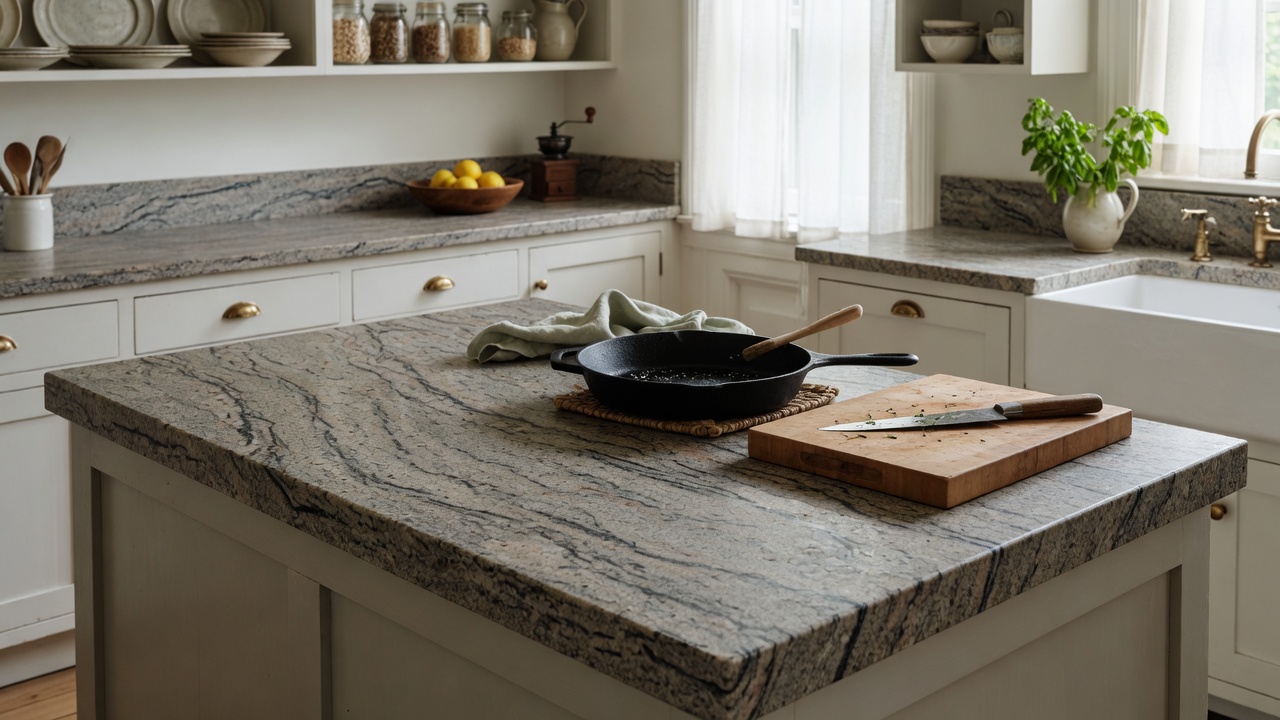
Granite gets a reputation as the countertop that can take anything. Most of that reputation is earned. But there's a difference between "handles it well" and "nothing can hurt it," and that gap is where people end up disappointed. Let's walk through what actually happens when heat and knives meet granite.
First, what granite is
Granite is an igneous rock, formed under heat and pressure deep in the earth over a very long time. That's why it holds up well to a hot pan on the counter. It's already been through far worse than your stovetop. The mineral grains (quartz, feldspar, mica) are hard and tightly interlocked, which is also why it resists scratching.
What happens when a hot pan lands on it
Set a pan straight off the burner onto granite and the stone itself usually won't crack or discolor from a quick, one-time contact. That's the part people hear and remember. What they don't hear is the rest of it: repeated thermal shock (hot pan, then a cold rinse, over and over in the same spot) can stress the stone over years. And if your granite has a seam near that spot, or if the pan sits there long enough to heat a wide area unevenly, you're rolling the dice.
Granite handles brief contact with a hot pan better than most surfaces, but we still tell every customer the same thing: use a trivet or hot pad. Every time. It's not because granite is fragile. It's because there's no upside to skipping it, and there's a real cost if things go wrong.
What happens when a knife meets it
Here's the one people get most wrong. Granite is hard, hard enough that a knife blade dragged across it is more likely to dull your knife than to mark the stone. That's true. But "resists scratching" isn't the same as "can't be scratched." Grit, sand, or a dropped cast iron pan can leave a mark, especially on a polished finish where any scuff shows up against the shine. And even if the stone wins that fight, your knife edge loses it.
Use a cutting board. Always. It protects your knife edge, and it keeps the counter looking new for the life of the kitchen.
Where the real risk actually lives
Most of the granite damage we see in the shop over the years didn't come from cooking. It came from renovation dust and grit tracked across the counter, from a heavy dropped object hitting an edge or a corner (edges chip more easily than the flat face), or from years of small scuffs adding up because nobody used a board. Heat damage is rarer than people expect, and scratch damage is almost always preventable with a two-dollar cutting board.
Where granite sits next to other stones
Quartzite is even harder than granite and resists scratching a bit better, though it can still scratch, so the cutting board rule doesn't go away. Quartz, on the other hand, is engineered with resin binding the stone dust together, and that resin can scorch or discolor under a hot pan in a way natural granite won't. If you're comparing slabs side by side, that's a real difference worth knowing, not a reason to skip the trivet on any of them.
The short version
Granite is one of the more forgiving surfaces you can put in a kitchen. It takes daily abuse better than laminate, butcher block, or quartz for heat resistance. But "better than most" isn't the same promise as "can't be hurt." A trivet and a cutting board cost you nothing in convenience and buy you a countertop that still looks new in fifteen years instead of one with a faded ring by the stove and a web of fine lines by the cutting spot.
If you want to see how different granite slabs actually look and feel before you commit, come by 2015 Charleston Hwy in Cayce. We'll show you the real thing, not just a sample chip.