
Care and maintenance
Does granite stain? here's what actually happens
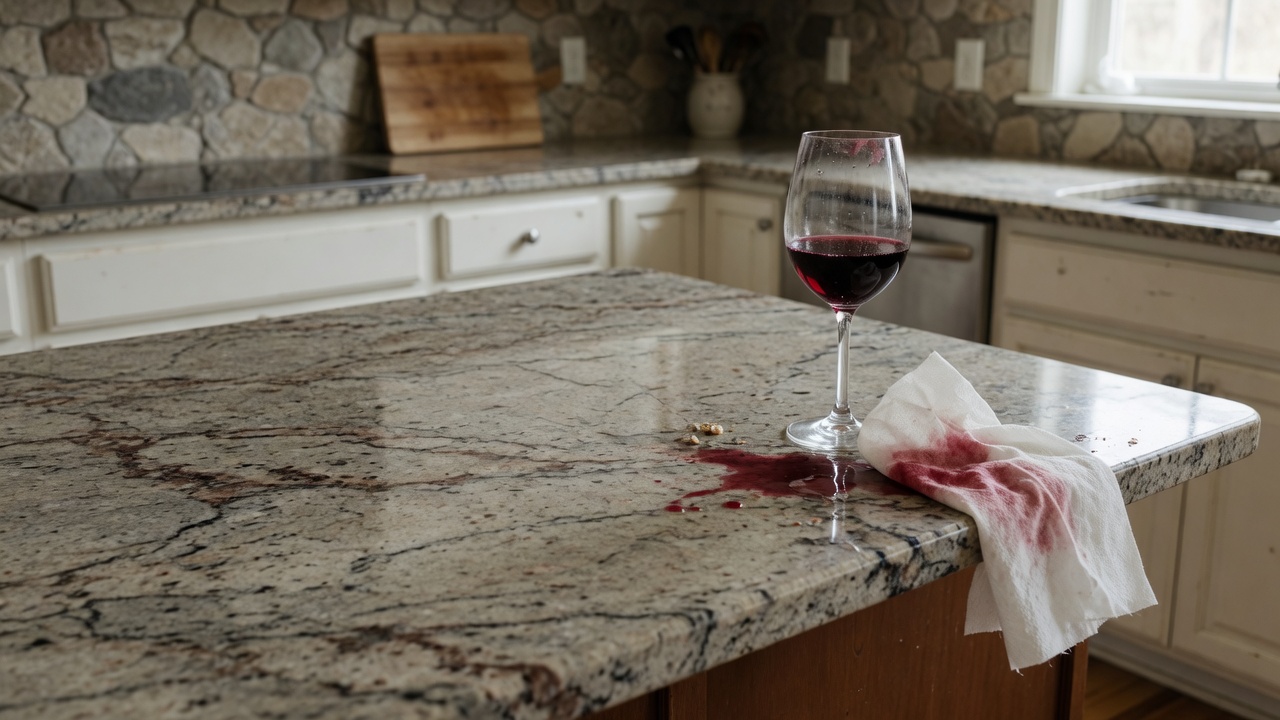
We get this question a lot, usually from someone standing at a slab with a glass of red wine in mind. Here's what we tell them.
Can granite stain at all?
Yes, it can. Granite is a natural stone, and natural stone has some level of porosity, meaning it has tiny openings that can absorb liquid. Sealing fills a lot of that space and slows absorption way down, but it doesn't turn the stone into plastic. If a spill sits long enough, especially something oily or dark like wine, coffee, or cooking oil, it can leave a mark. It's not common on a sealed granite in a normal kitchen, but it's not impossible either.
Why does granite absorb anything in the first place?
Granite formed from cooled magma, and depending on the specific slab, it can have a tighter or looser crystal structure. Some granites are nearly as dense as glass. Others have more natural porosity. That's part of why two granite countertops can behave a little differently even though they're both called granite. A slab's trade name tells you what it's marketed as, not exactly how it will perform, so we go by how the stone actually behaves when we're fabricating it.
Does sealing actually stop stains?
Sealing helps a lot. It fills the pores near the surface so liquid beads up instead of soaking in, which buys you time to wipe up a spill before it becomes a problem. We seal every job at install with a good sealer, applied by installers we train to do it right. A lot of shops hand you the countertop and leave sealing up to you. We don't do that. Sealing isn't a forever fix, though. It wears down over years of use and cleaning, so we recommend resealing periodically, usually about once a year for most kitchens, more or less depending on how the counter gets used.
What actually causes most granite stains?
In our experience it's almost always the same short list: cooking oil left around a stove, wine or coffee left overnight, and sometimes hard water buildup around a sink edge if it's never wiped dry. The pattern is time. A spill wiped up in a few minutes is rarely a problem. A spill that sits overnight, especially something oily, has a much better chance of soaking in enough to leave a shadow.
If it does stain, is that permanent?
Often not. Many granite stains are actually oil or liquid trapped just under the surface, and a poultice (a paste cleaner made for stone, left on and covered for a day or so) can pull a lot of that back out. Results depend on how deep it went and how long it sat, so we'd rather help you avoid it than fix it after the fact. If you're ever unsure, bring us a photo before you try anything harsh on it.
What should I actually do day to day?
Wipe up spills when they happen, especially wine, oil, and citrus. Use a cutting board instead of cutting directly on the stone, it protects your knives too. Use coasters under oily bottles like olive oil that tend to sit on the counter. And keep up with resealing on whatever schedule your fabricator recommends for your specific granite. None of this is complicated, it's mostly just not letting liquid sit around for hours.
So is granite a good choice if I'm worried about stains?
It's one of the more forgiving natural stones out there, and with a good seal job and normal cleanup habits, staining is genuinely rare. If you want a non-porous option that skips sealing altogether, quartz is worth a look too. But plenty of our customers have had granite for years without a single stain, because they just wipe up messes like they would on any other counter.
If you want to see how different granite slabs actually feel and look in person, come by 2015 Charleston Hwy in Cayce. We're happy to walk you through which ones are denser, which need more attention, and which will fit how your kitchen actually gets used.