
Buying guides
Choosing granite: why the slab you see is the slab you get
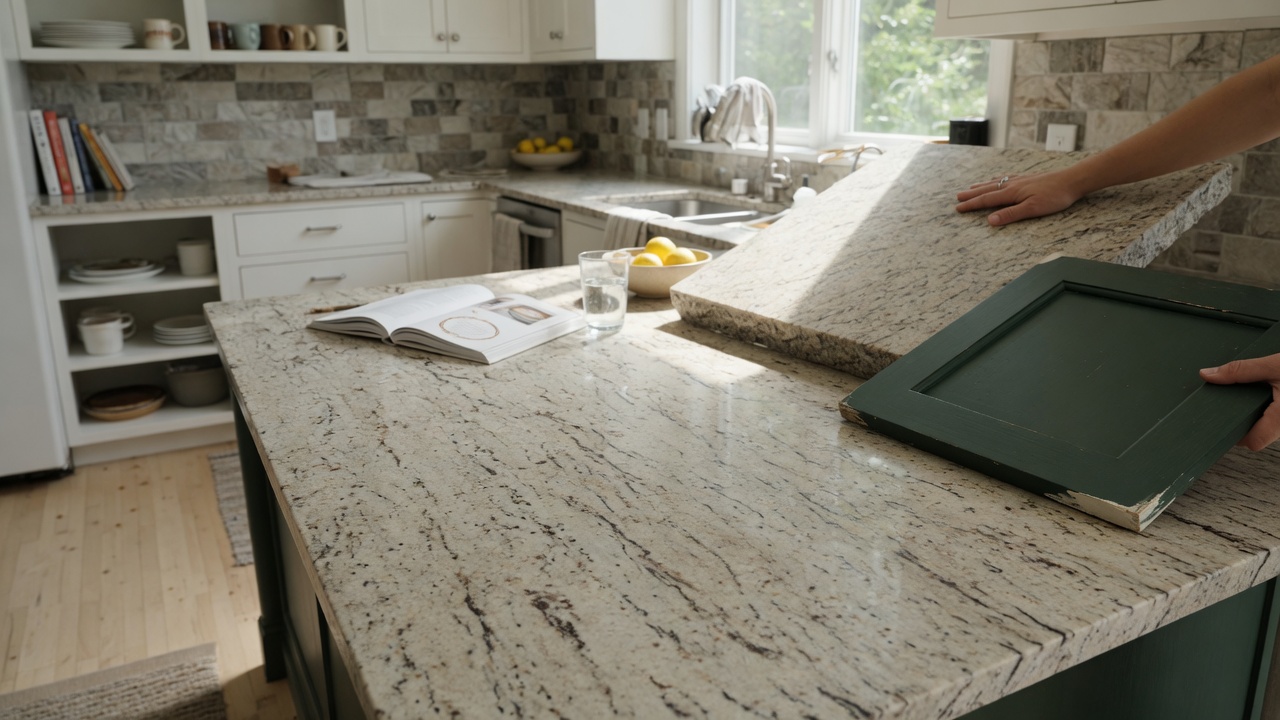
The myth: 'granite' means one consistent look
A lot of folks walk in thinking that if they pick "granite" as their material, they'll get a fairly uniform product, kind of like picking a paint color off a swatch. Order "Black Pearl" or "Santa Cecilia" and you'll get exactly what's on the little sample chip at the showroom.
It doesn't work that way, and once you know why, picking a slab gets a lot easier.
The real story: granite is a trade name, not a formula
Granite is a natural rock, formed from cooled magma with mineral grains packed together over a very long time. Trade names like "granite" (and even specific names like "Santa Cecilia") describe a category of stone that comes out of a particular quarry region, not a single fixed recipe. Two blocks pulled from the same quarry, even blocks that are stacked right next to each other, can show different background color, different mineral flecking, and different vein movement.
That's why the little sample chip at a showroom is a starting point, not a promise. It tells you the general family (warm beige with burgundy flecks, cool gray with black veining, whatever the case may be). It doesn't tell you what your actual slab will look like, because your actual slab hasn't been picked yet.
Why seeing the actual slab matters
This is the part we push hardest on: come look at the slab that will become your countertop, not just a sample of the same name. When you're standing in front of it, look for:
- Background color under different light. A slab can look one shade under warehouse fluorescents and another under your kitchen's window light.
- Vein direction and movement. Some granites have bold, sweeping veins; others are more speckled and uniform. Decide which one fits the size of your kitchen. Big dramatic veining can overwhelm a small galley kitchen, while it might be the whole point in an open, larger space.
- Consistency across the slab. Granite often varies from one end of the slab to the other. Ask where your sink cutout and seams will fall, and picture how the pattern lines up on either side.
- Natural inclusions. Small mineral clusters, fissures, or pits are normal in granite. They're part of how the stone formed, not defects to reject a slab over.
Matching it to cabinets and light
A few practical habits help here:
- Bring a cabinet door sample or a paint chip with you when you look at slabs. Lighting in a stone yard is nothing like your kitchen.
- Look at the slab near a window or under a portable light if you can, especially if your kitchen gets strong natural light during the day.
- Think about contrast on purpose. A busy, veined granite next to busy cabinet grain can fight itself. A calmer granite lets bolder cabinets or a patterned backsplash do more of the talking, and vice versa.
- Ask about the whole slab, not just the visible face. Some yards will tip a slab or show you a photo of the full sheet so you're not guessing at what's under the top layer of dust.
The upkeep side, briefly
Granite is porous to some degree, like most natural stone, so it should be sealed and resealed periodically, usually about once a year for a typical kitchen. Even sealed, a spill left overnight can still stain, so wipe up wine, oil, or citrus when it happens. Granite handles brief contact with a hot pan better than most surfaces, but we still say use a trivet, every time.
If you're picking granite for a project, come look at actual slabs at our yard on Charleston Hwy in Cayce. Standing in front of the real thing, in real light, is worth more than any catalog photo we could show you.