
The work
Templating and fabricating dolomite: how it compares to granite and quartzite
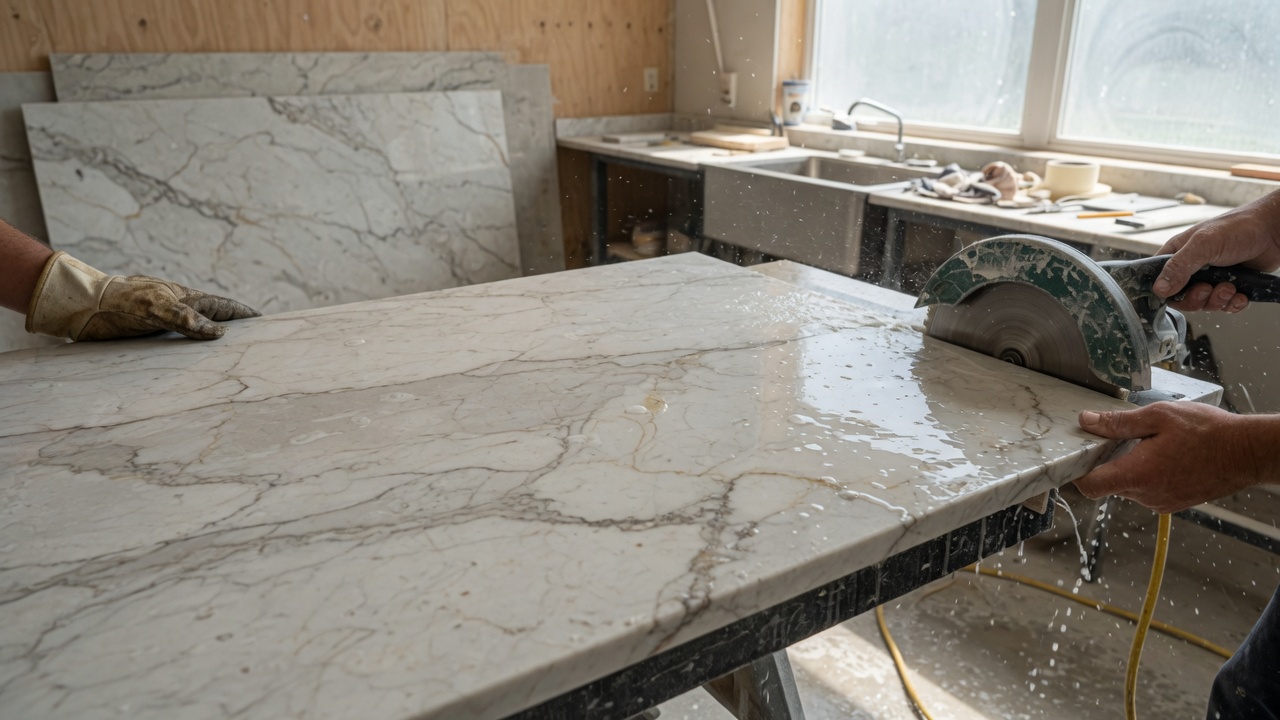
Dolomite gets sold as a tougher alternative to marble, and it mostly earns that reputation. But in the shop, it doesn't fabricate exactly like granite or quartzite either. It sits in its own spot, and knowing where helps explain why we make certain calls on templating and seam placement.
Here's how the two paths compare, stage by stage.
Templating day
Dolomite
- We look hard at vein movement and any natural pitting before we ever pull out the laser or the template sticks. Dolomite slabs often have softer, chalkier zones near heavy veining, and we mark those as areas to avoid for stress points like sink cutouts.
- We check slab thickness variation more carefully. Dolomite can run slightly uneven across a single slab compared to a dense granite.
- Seam placement gets planned around the vein pattern first, structural spans second. On a granite job, it's often the reverse.
Granite and quartzite
- Templating is more about layout and appliance fit. The stone itself is consistent enough that we're not hunting for weak zones.
- Seam placement leans hard on span and support, since the material itself rarely dictates where a seam has to go.
Cutting and shaping
Dolomite
- It cuts cleaner than marble but still asks for slower feed rates on the saw than granite does. Push it too fast and you risk chipping along the edge of the cut.
- Corners and cutouts (sink, cooktop) get extra support blocking before the cut. Dolomite can be brittle right at a stress point, more so than granite, less so than marble.
- Edge profiles that involve tight detail, like a small ogee, take more hand finishing time because the material doesn't hold a crisp micro-edge quite as well as harder stone.
Granite and quartzite
- Both cut fast and predictably. Quartzite in particular is one of the harder stones we cut, so it holds detail well but wears blades faster.
- Cutouts don't need the same babying. The material is less likely to chip at a stress point during fabrication.
Polishing
Dolomite
- Polishes up with a nice soft luster, close to marble's look, which is the whole reason people choose it.
- Polishing changes shine, not porosity. We still treat every dolomite top as something that needs sealing, same as we would granite or marble, because a polished surface absorbs about what a honed one does.
Granite and quartzite
- Also gets sealed at install. People assume granite doesn't need it because it's so hard, but it's still a natural, porous stone. We seal it regardless.
- Quartzite can take a higher shine and hold it a bit longer under daily wear.
Seams and why they land where they do
On any stone, seam location is a mix of slab size, kitchen layout, and appliance placement. Dolomite adds one more variable: vein direction. We'd rather run a seam through a busy part of the pattern where it visually disappears than through a plain stretch where a straight line stands out.
Granite seams get planned mostly around structural span and where cabinets can support the joint. There's less pattern-matching involved because most granites don't have the long, sweeping veining that dolomite or marble does.
Install day
Dolomite
- Setters handle the piece a little more carefully coming off the truck and going onto the base cabinets, especially long runs. It's not fragile, but it's not granite either.
- Sealer goes on as part of our install, same as with any natural stone job. That's the coat that matters most, and we handle it, not the homeowner, on install day.
Granite and quartzite
- Handling is more forgiving during the move and set. Fewer surprises at this stage.
- Sealing still happens. Non-negotiable step regardless of which stone is going in.
Who each one suits
If you want the soft, veined look of marble and you're willing to treat the surface with a little more care, use a cutting board, wipe up citrus and wine promptly, and reseal on a normal yearly schedule, dolomite is a strong choice. It resists etching better than true marble, though it's still a carbonate stone and can etch under prolonged acid contact, so it's not a stone you'd want to be careless with lemons on.
If you want the toughest daily-use surface with the least babying, granite or quartzite is the more forgiving pick. Quartzite in particular resists scratching well and takes brief heat better than most stone, though we still say use a trivet, no exceptions, on any natural stone or quartz.
A slab's name on the yard tag doesn't tell the whole story either way. Some stones sold as dolomite behave more like true marble, and some sold as quartzite lean softer than the name suggests. We go by how the actual slab performs on the saw and under a test scratch, not just what's printed on it.
If you're weighing dolomite against granite for a kitchen, come look at slabs in person at 2015 Charleston Hwy in Cayce. Seeing the veining under real light and running a hand over a few finished edges tells you more than any spec sheet will.