
Buying guides
Do dark countertops really show every crumb?
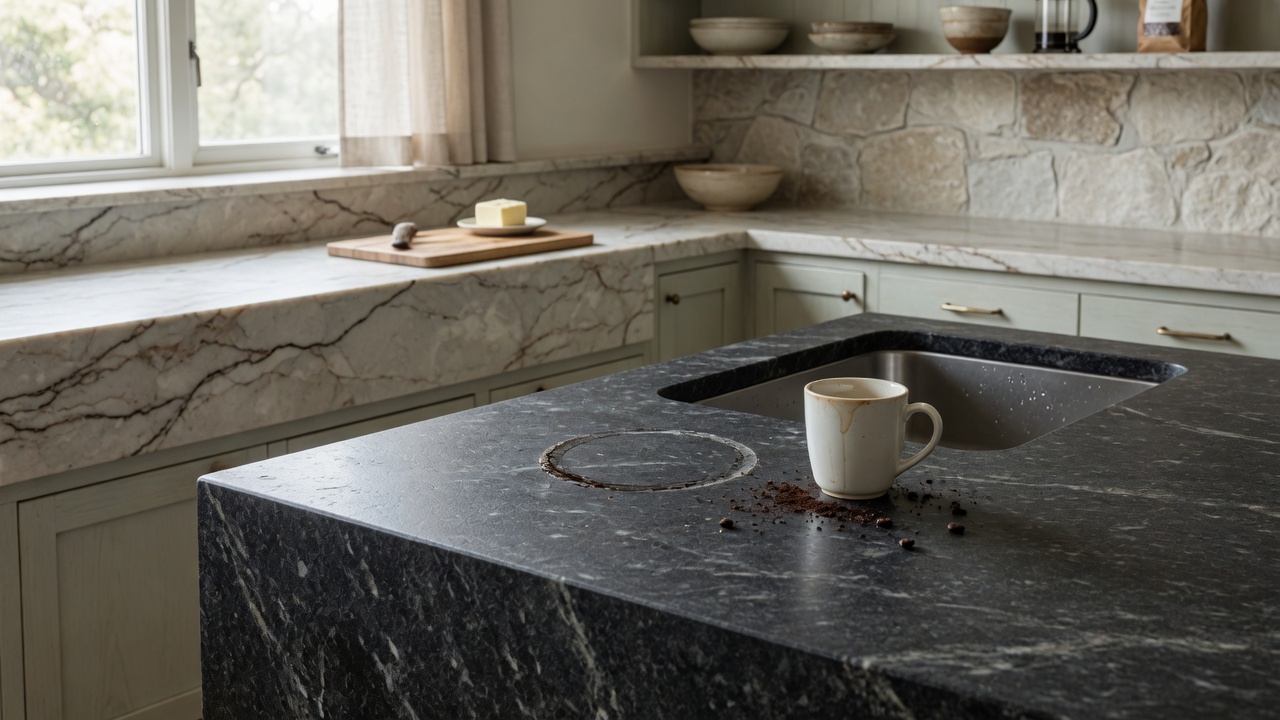
Yes, mostly. If you've got a black or dark charcoal countertop and you're wondering why it looks dusty five minutes after you wiped it down, you're not imagining it. But the full picture is a bit more interesting than "dark is bad."
Why dark surfaces show more
Dark stone has almost no visual noise to hide things in. Flour dust, coffee grounds, pet hair, even plain tap water left to dry, all of it shows up as a light mark against a dark background. Your eye catches contrast fast, and a dark polished surface is nothing but contrast waiting to happen.
Water spots are the big one people don't expect. Hard water leaves a faint ring when it evaporates, and on a black countertop that ring reads clearly under kitchen lighting. Wipe with a dry cloth right after you rinse dishes near it and it mostly goes away.
Why light surfaces show different things
Light stone doesn't hide crumbs and dust so much as it blends them in. A light gray or white countertop with a busy pattern camouflages a lot of daily mess, which is part of why patterned slabs stay popular in busy kitchens.
But light stone has its own tell: stains and seams. A red wine spill or an oil ring shows up faster on white than on black. And a seam line, the spot where two slab pieces meet, is more visible on a plain light surface than on a dark one where the seam blends into the color.
So it's not that one color hides mess and the other doesn't. Each hides something different and shows something else.
Finish matters as much as color
A honed (matte) finish in either color hides dust and light scratching better than a high polish. Polish reflects light, and reflected light shows every fingerprint and water spot. Honed dark stone still shows more than honed light stone, but the gap is smaller than it's with two polished slabs side by side.
Pattern helps too. A dark stone with visible movement, quartz or granite with flecks and veining, hides daily dust noticeably better than a flat solid black. Solid colors, light or dark, are the ones that show the most because there's nothing in the surface to break up what lands on it.
What we tell customers
If you cook a lot and want low visible mess between wipe-downs, go with a mid-tone or patterned stone rather than a flat solid, light or dark. If you love the look of a deep black or charcoal island, know you'll be wiping water spots more often, and keep a microfiber cloth close by. It's a real tradeoff, not a flaw in the stone.
Best way to judge it's to stand over a full slab in real light, not a small sample chip. Come by 2015 Charleston Hwy in Cayce and look at a few finishes side by side. You'll see the difference in about thirty seconds.