
Buying guides
Countertop edge profiles, explained
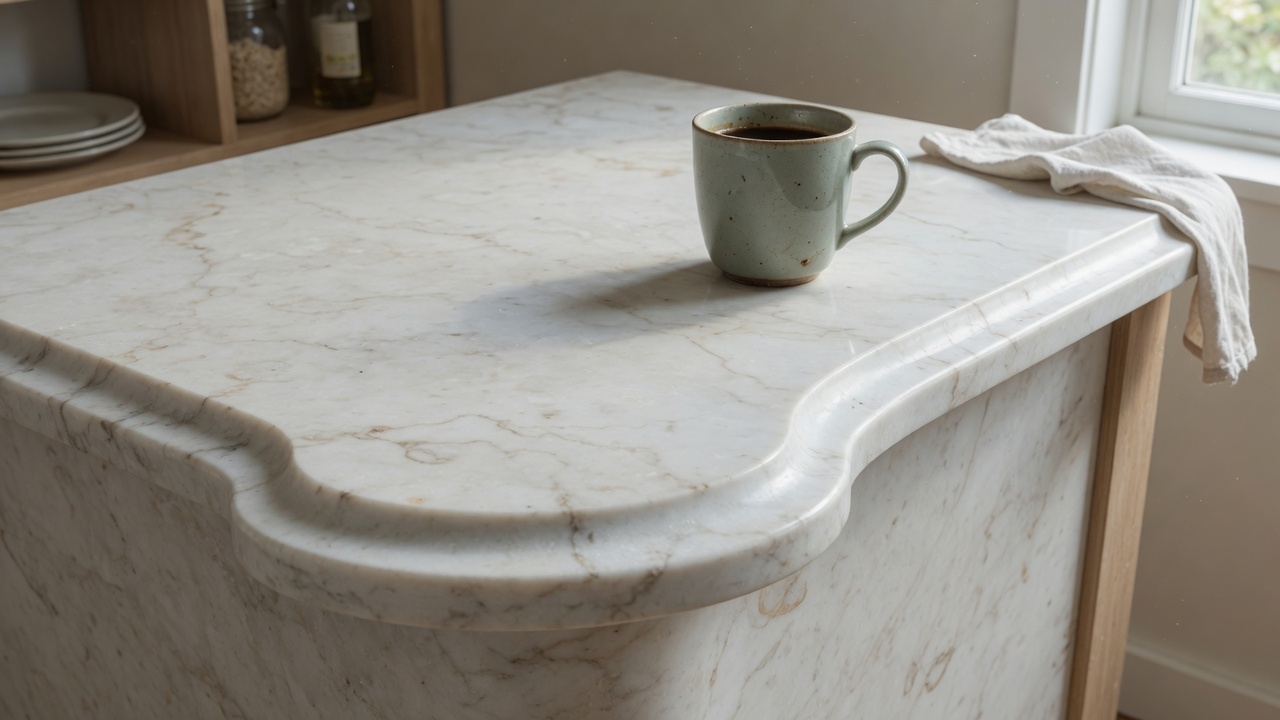
The edge profile is one of the last things people think about when picking a countertop, and one of the first things they'll touch every single day. It shapes how the light hits the slab, how the room reads, and honestly how the counter feels under your hand when you're leaning on it doing dishes. Here's a rundown of the edges we cut most, what they look like, and roughly what they run.
Eased edge
This is a straight edge with the sharp top and bottom corners softened just slightly, so you don't get a razor line where you might bump a hip or an elbow. It's the simplest cut we do and usually comes standard, meaning it's included in most base pricing rather than charged as an upgrade.
- Look: clean, modern, minimal. Reads well in a contemporary kitchen and doesn't compete with a busy stone pattern.
- Cost: typically included at no extra charge, since it's the least labor-intensive profile to cut and polish.
- Best for: kitchens where the stone itself is the star and you don't want the edge pulling focus. Also a smart pick if you're on a tight budget and want to put money into the slab instead of the edge.
Beveled edge
A beveled edge cuts a flat angled face along the top, usually somewhere between a 1/8 inch and 1/4 inch angle, giving the counter a slightly faceted look instead of a hard 90 degree corner.
- Look: a little more detail than eased without looking ornate. It catches light along that angled line, which can be nice on darker granite or quartzite.
- Cost: often a modest upgrade over eased, since it takes an extra pass to cut and polish that angled face.
- Best for: transitional kitchens, somewhere between traditional and modern, where you want a touch more style without going fancy.
Bullnose edge
Bullnose rounds the top edge into a smooth curve. A half bullnose rounds just the top corner and leaves the bottom square; a full bullnose rounds the entire edge top to bottom into a half circle profile.
- Look: soft and traditional. No sharp corners at all, which a lot of families like for safety around kids.
- Cost: moderate upgrade, more labor than eased or beveled since the whole curve has to be shaped and polished evenly.
- Best for: households with young kids, older homes with a traditional style, or anyone who just doesn't want a hard corner at counter height.
Ogee edge
Ogee is the fancy one, an S-curve profile that cuts in and then back out, creating a decorative shadow line along the top of the counter. You'll see it most on marble and lighter granite in more formal kitchens.
- Look: detailed and traditional, almost architectural. It's the edge that makes a plain slab look dressed up.
- Cost: the most labor-intensive common profile, so it carries the biggest upgrade charge of the standard options. Worth asking us for a current quote since it varies by shop and by how much edge footage you have.
- Best for: formal dining spaces, islands meant to be a visual centerpiece, or a kitchen with raised panel cabinets and other traditional millwork where the extra detail fits the room.
Waterfall edge
This isn't really an edge profile so much as a whole design move. Instead of finishing the counter at the cabinet edge, the stone continues straight down the side of the island to the floor, mitered at the corner so the veining or pattern looks continuous.
- Look: dramatic and modern. It's the edge people point to in photos because it turns the island into a piece of furniture.
- Cost: the most expensive option on this list by a wide margin, since it uses significantly more material (a whole extra panel of slab) and takes real skill to miter the corner so the pattern lines up.
- Best for: islands in open concept kitchens where the island is a focal point, and for stones with strong veining like marble-look quartzite, where a continuous pattern down the side actually shows off the slab.
How to actually choose
- Match the edge to your cabinet style first. Shaker and modern cabinets usually want eased or beveled. Raised panel and traditional cabinets can carry a bullnose or ogee without looking busy.
- Think about who's in the house. Toddlers and hard ogee corners on a peninsula don't mix well; a full bullnose is the safer call.
- Let the stone lead on waterfall. A quiet, uniform stone can look flat wrapped down an island side. A stone with real movement in the veining is what makes that cut worth the material cost.
- Ask to see the edge cut on an actual offcut of your slab before you commit. A profile looks different on paper than it does catching real light off your chosen stone, and we're happy to cut a sample so you can see it before it's on your counter for good.
If you're not sure which one fits your kitchen, come by 2015 Charleston Hwy in Cayce and we'll show you a few edges cut into scrap pieces so you can run your hand over them and see how the light hits each one. It's a five minute conversation that saves a lot of second-guessing later.